


What is skill mapping? A complete guide for HR, managers, and people leaders
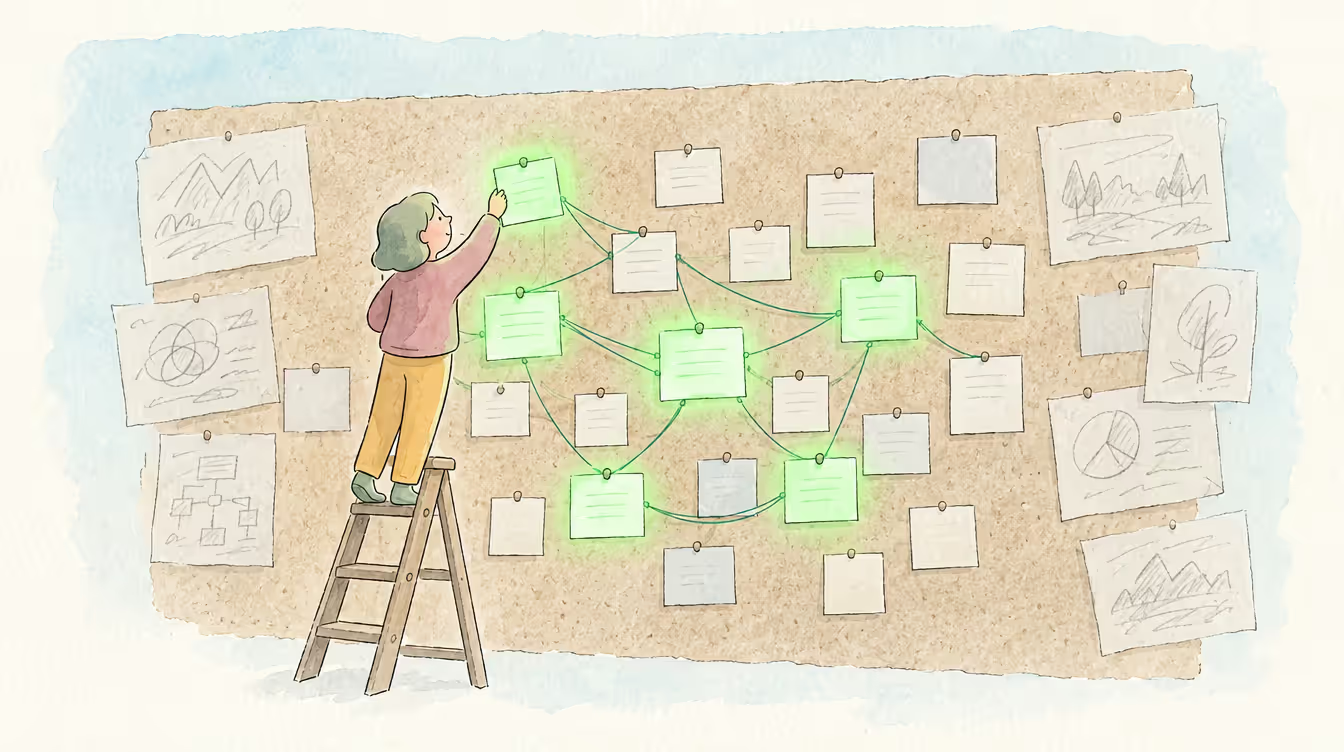
Skill mapping is the process organisations use to understand what their workforce can actually do.
Ask a senior manager how their team is doing and they will probably give you a confident answer. Ask them to name the three skills their team most critically lacks, or which employees could step into a more senior role tomorrow, and the confidence tends to fade. It is not a failure of leadership. It is a data problem.
Skill mapping is how organisations close that gap – moving from assumptions and gut feel to a clear, structured picture of what their workforce can actually do. Done well, it underpins everything from team building and succession planning to recruitment decisions and L&D investment. Done poorly – or not at all – it leaves organisations making important people decisions with incomplete information.
This guide explains what skill mapping is, how it works in practice, how it connects to the skills matrix, and how to build a process that actually holds up over time.
What is skill mapping?
Skill mapping is the process of identifying, capturing, and organising the skills, competencies, and proficiency levels of individuals across a team or organisation. The goal is to create a structured, queryable picture of workforce capability – one that can be used to make better decisions about how people are deployed, developed, and recruited.
At its core, skill mapping involves three things: deciding which skills matter for your organisation, capturing what your people actually have and at what level, and making that information visible and usable for the people who need it.
A skill map might cover technical skills, behavioural and cultural competencies, certifications, languages, or domain-specific knowledge. What matters is that it reflects reality – not job titles, not assumptions, but verified data on what people can actually do.
Skill mapping vs. a skills matrix: What's the difference?
The terms are closely related and often used interchangeably, but they describe different things.
A skills matrix is the output – a visual representation of skills and proficiency levels mapped across a team or role. It shows you, at a glance, who has which skills and at what level.
Skill mapping is the process that produces and maintains that matrix. It includes deciding which skills to track, building or importing a skills taxonomy, collecting skills data from employees, defining proficiency levels, and keeping the information accurate over time.
Think of skill mapping as the methodology and the skills matrix as the tool. One without the other has limited value. A skills matrix built on outdated or incomplete data does not give you skills intelligence – it gives you a false sense of it. And a mapping process with no clear output format gives you data with nowhere useful to go.
The practical implication is this: If your organisation already has a skills matrix – whether in a spreadsheet or a dedicated platform – it has the beginnings of a skill mapping practice. The question is whether that practice is producing data accurate enough, and current enough, to support real decisions. For most organisations running static spreadsheets, the honest answer is no.
Why skill mapping matters
The underlying logic is straightforward. When the right person is matched to the right task, with the right skills and the right level of proficiency, productivity, quality, and engagement all improve. The challenge is that in any organisation of meaningful size, maintaining that match manually – and keeping it current as people develop and roles evolve – becomes practically impossible without a structured approach.
Why organisations invest in skill mapping
Workforce planning: You cannot plan for future capability needs without knowing your current baseline. Skill mapping tells you where you are strong, where you are exposed, and what the gap looks like between where you are and where you need to be.
Recruitment: Hiring decisions made without a clear view of existing skills risk duplicating capability you already have or missing the specific gap that matters most. A skill map shows you exactly what is missing before you write a job description.
Skills gap analysis: Identifying the gap between current capability and what a role, project, or team actually requires becomes a data exercise rather than a guessing exercise.
Internal mobility: Employees who want to develop often do not know which roles their current skills make them a realistic candidate for. Skill mapping makes that visible – to the employee and to their manager – turning career conversations from vague encouragement into specific, data-backed plans.
Risk management: Organisations that rely on a single expert for a critical capability are exposed. Skill mapping surfaces that dependency before it becomes a crisis – and before that person hands in their notice.
What skills should you map? A complete breakdown
A complete skill map typically captures several dimensions of capability, not just technical skills.
Hard skills and technical competencies: tools, technologies, programming languages, methodologies, domain expertise. The most commonly tracked category, and the easiest to define.
Behavioural and cultural skills: Problem solving, communication, teamwork, leadership, psychological safety. These are often underrepresented in skills data but disproportionately important for team performance. An engineering team with strong technical skills and weak collaboration skills is a team that will struggle regardless of what the technical map looks like.
Certifications and validated credentials: Qualifications that have been formally assessed, with issue dates and expiry where relevant. Particularly critical in regulated industries where an expired certification is a compliance risk, not just a development gap.
Proficiency levels: Not just whether someone has a skill, but how developed it is. An organisation with 10 people who are all beginners in a critical technical skill is in a fundamentally different position from one with two experts who can transfer knowledge and mentor others. That distinction is invisible in a simple yes/no matrix, and it matters enormously.
Interests and preferences: Some organisations extend their skills mapping to capture what people enjoy working on, not just what they can do. This is particularly useful for internal mobility and team composition, where motivation is as relevant as capability.
How to build a skills taxonomy for skill mapping
Before you can map skills, you need to agree on which skills to track. This is the skills taxonomy – the structured, curated list of skills your organisation has decided are important to measure and develop.
A comprehensive skills library may contain tens of thousands of skills. MuchSkills, for instance, has an extensive skill libraries organisations can use as a starting point. It contains more than 70,000 contemporary skills, 12,000 technical skills, and 9,700+ certifications. That comprehensiveness is useful as a reference library.
But for practical skill mapping, what you need is a focused subset: the skills genuinely relevant to your work, your roles, and your strategy.
A well-designed taxonomy makes it easier for employees to accurately describe what they can do, makes data comparable across teams, and focuses development energy on what actually matters. A taxonomy that tries to track everything ends up tracking nothing reliably.
Building one typically involves reviewing your roles and job descriptions, identifying the skills and competencies most critical to delivery quality, and adding any strategic or behavioural priorities the organisation wants to cultivate. In MuchSkills, the platform provides a default taxonomy that organisations can use as a starting point, modify, or replace entirely with their own – which significantly reduces the time between deciding to map skills and actually having data to work with.
The taxonomy is not a one-time decision. As roles evolve, new technologies emerge, and strategic priorities shift, it needs to evolve with them.
How to do skill mapping: a step-by-step process
Once the taxonomy is in place, the mapping process involves several stages.
Defining roles and competency profiles: For skill mapping to drive decisions, you need to define what good looks like for each role – which skills are required, which are prioritised, and at what level. This is what transforms a list of employee skills into a gap analysis. In MuchSkills, you can describe a role or paste a job description and the platform's AI generates a suggested skill profile based on your taxonomy, which you review and refine. What might previously have taken days of workshop time can be done in an afternoon – and the output is immediately connected to your live workforce data.
Capturing skills data: Employees add their skills, proficiency levels, and certifications to their profile. This works best when it connects to a natural moment – updating before a one-on-one, during a quarterly review, or when preparing for a project assignment. Skills data collected without a clear reason tends to be rushed and unreliable. The most effective organisations build the update into a process that already exists rather than creating a separate task for it.
Running the analysis: With employee skills captured and role profiles defined, the skills gap analysis can run automatically. In MuchSkills, you can see across any team or department which skills are well represented and which are thin – and at what proficiency level. Filters by manager, department, location, or seniority allow you to narrow the view to exactly the population you need.
Keeping data current: Skill mapping is not a one-time project. Skills change – people develop, roles evolve, and new hires bring new capability. Data that has not been updated for several months is increasingly unreliable. A practical benchmark is quarterly updates, timed to coincide with check-ins or development conversations. MuchSkills flags profiles that have not been updated within a defined period – typically around 90 days – so managers can see at a glance which data is fresh and which needs attention.
How to use skill mapping for teams, leadership, and culture
One of the most underused aspects of skill mapping is its application beyond individual role definitions.
A skill map can be built for a team or department – not to describe one person's role, but to define the combined capabilities the team needs to deliver its work. Sitting with a team and asking "are we collectively well equipped for what we are being asked to do?" is a fundamentally different conversation from a standard performance review. Skill data makes it a structured one rather than a speculative one. In practice, this kind of session tends to surface both gaps no one had articulated and strengths the team had not recognised in itself.
Skill maps can also be built around strategic behaviours. An organisation that wants to become genuinely good at data-driven decision making, or that is trying to build a high-performance culture, can define the skills associated with that aspiration and track where the organisation currently sits. The ambition becomes something you can measure – and therefore something you can actually make progress on.
Leadership competency mapping is another high-value application. Rather than creating a separate skill profile for every management title, a shared leadership competency framework makes it possible to assess current leaders against a consistent standard – and to identify employees not currently in management roles who already have the foundational skills to grow into them. That is succession planning based on evidence rather than instinct.
How skill mapping supports strategic workforce planning
Skill mapping is the foundation of strategic workforce planning, not just an input to it.
An organisation that knows its current skill distribution can model what happens when it pursues a new strategic direction, enters a new market, or adopts a new technology stack. Where are the gaps? What needs to be hired for? What can be developed internally, and over what timeline? Those are answerable questions when you have a live skills map. Without one, they are answered with estimates – and the decisions that follow are weaker for it.
How to start skill mapping in your organisation
Skill mapping does not require a perfect taxonomy, a complete dataset, or an enterprise-wide rollout on day one. The most common mistake is treating it as a one-time project with a defined end state rather than an ongoing capability that improves incrementally.
A practical starting point: pick one team or department, define the skills most relevant to their work, ask people to self-report their proficiency levels, and compare the result against your role requirements. What you find – gaps you did not expect, strengths you did not know you had – is usually enough to make the case for doing it more systematically.
MuchSkills gives HR teams, managers, and L&D leaders a modern skills matrix built for ongoing skill mapping — with a database of 70,000+ skills, AI-assisted role definition, automated data freshness prompts, and the reporting tools to turn skills data into decisions that actually hold up.
Ready to see skill mapping in action? Watch the HR & L&D demo →
Frequently asked questions



What is the difference between skill mapping and a skills audit?
A skills audit is typically a one-time exercise to assess current capabilities at a point in time, often as part of a strategic review. Skill mapping is an ongoing process – a living system that captures, updates, and analyses skills data continuously. An audit can be a useful starting point for skill mapping, but it is not a substitute for it.
How do you define proficiency levels in a skill map?
MuchSkills recommends a three-level framework: beginner (developing the skill, not yet independently productive), intermediate (able to apply the skill independently in most situations), and expert (deep expertise, able to guide and mentor others in complex scenarios). Within each level there are gradations – so a strong intermediate is meaningfully different from someone just crossing the beginner threshold, and the data can reflect that nuance. What matters most is that the definitions are agreed internally and applied consistently. Inconsistent proficiency standards across teams undermine the comparability of the data.
How often should skill data be updated?
Quarterly is a practical benchmark for most organisations, aligned to regular one-on-ones or development conversations. The key is making updates a natural part of an existing process rather than a standalone task. Skills data that sits outside the flow of normal work tends not to get maintained.
Can skill mapping work for small teams?
Yes – and the value is often immediately visible at small scale. A team of 15 people with a clear skill map and defined role competencies can make faster staffing decisions, have better development conversations, and identify gaps before they become problems. The approach scales, but the value does not require scale to be real.


Ready to see what your teams can do?
MuchSkills turns the skills scattered across CVs, spreadsheets and heads into one living map — so staffing, planning and development decisions start from evidence, not guesswork.