Skills for Data Analysts
The complete skill set for data analysts — priority skills, specialist analytical capabilities, and human skills. Map and track them with MuchSkills.
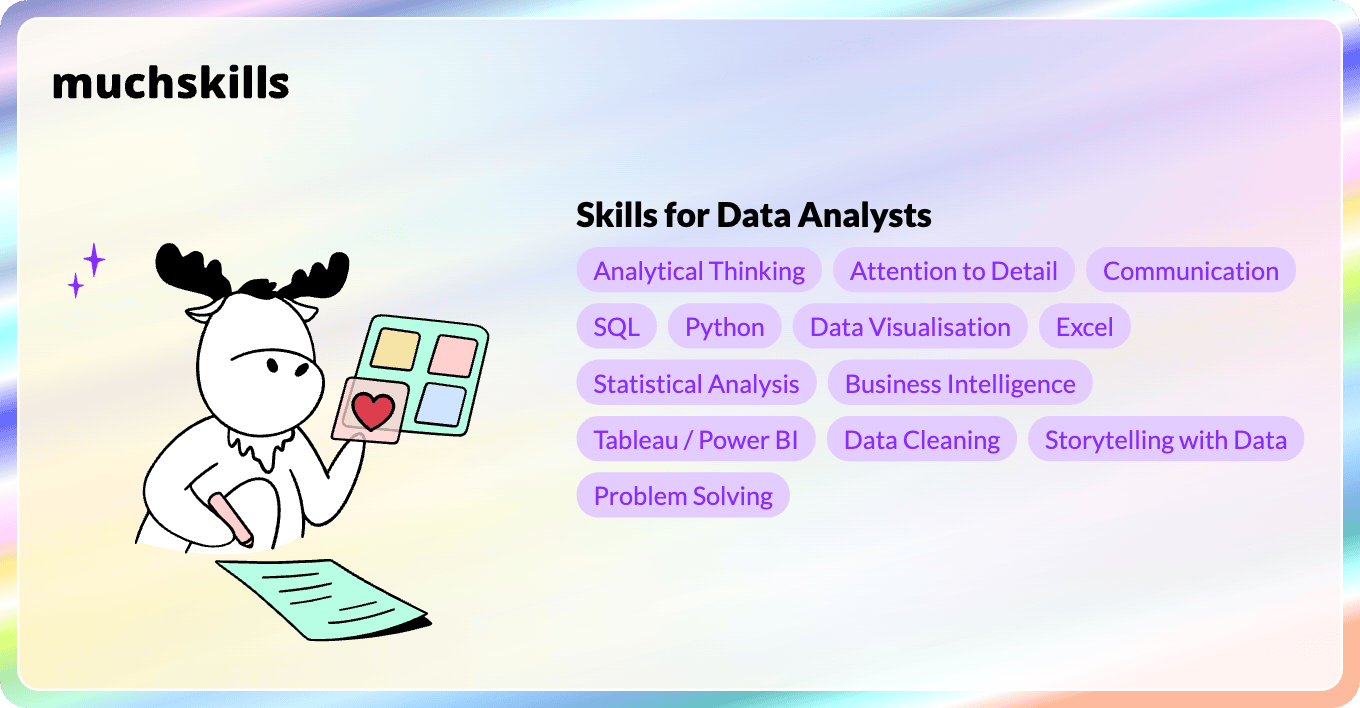
Skills and technical tools added by professionals on MuchSkills globally
Network engineering skills tracked across teams in the MuchSkills platform
More likely to place talent effectively — skills-based organisations vs traditional role-based ones (Deloitte)
Data Analyst Skills: The Complete Overview
Data analyst roles have expanded significantly as organisations generate more data and expect faster, more precise insights. Today's data analyst is expected to clean and model data, build visualisations, work with BI tools, and communicate findings to non-specialist stakeholders. Without a structured view of skills, it's difficult to staff analytical functions well or develop analysts toward senior capability — which is exactly the problem skills intelligence is built to solve. MuchSkills gives data leaders and HR teams the visibility to change that.
When organisations hire data analysts primarily on tool familiarity, they often miss the broader skill set that determines insight quality and business impact. A structured skills framework makes it possible to identify where analytical capability is concentrated, where critical gaps exist, and what development investment would have the most impact.
Core priority skills for data analysts
The skills most consistently prioritised for this role include Active Learning (Growth Mindset), Attention to Detail, Problem Solving, Critical Thinking, Teamwork and Collaboration, Communication, Business Acumen, and Data Analysis. These represent the capabilities that matter most — not just at hiring, but throughout a data analyst's development.
Data specialisation
Data analysts require depth in both technical and analytical skills. Key specialist skills include Data Analysis, Data Visualisation, Statistical Analysis, SQL and database querying, BI tool proficiency (Power BI, Tableau, Looker), and increasingly, Python for data manipulation. Analysts who understand the business context of their data — and who can translate technical findings into commercial insight — consistently deliver more value.
Essential human skills
The human skills most central to data analysis include Active Learning, Attention to Detail, Critical Thinking, and Communication. Data analysts who can communicate findings clearly to non-technical audiences, and who question their own assumptions as rigorously as the data, are significantly more valuable than those who optimise for technical depth alone.
Mapping data analyst skills across your organisation
Understanding which data analyst skills exist — and at what proficiency level — is the starting point for better hiring and development decisions. Competency mapping for analytical roles is particularly useful here — distinguishing analysts who can design a model from those who can run a report is a meaningful difference that job titles rarely capture. MuchSkills maps the full data analyst skill set across individuals and teams, giving data leaders and HR a continuously updated view of real analytical capability. See how MuchSkills tracks data analyst skills across your team.
Data analyst capability is most usefully mapped alongside data scientist skills — where the boundaries between analytical and predictive work become visible across the team.
Frequently asked questions
What are the most important skills for a data analyst?
The most important data analyst skills span both technical and human capabilities. Core technical skills include Data Analysis, Data Visualisation, SQL, Statistical Analysis, and BI tool proficiency. Essential human skills include Critical Thinking, Communication, and Business Acumen — the ability to translate data into decisions that make commercial sense.
How do organisations track data analyst skills effectively?
Effective skills tracking for data analysts requires going beyond tool certification or academic qualification. Organisations that maintain accurate skills visibility use a dedicated skills matrix that captures both technical skills and proficiency levels, updated continuously. This makes it possible to identify who can build an executive dashboard versus who can design an analytical model — a meaningful distinction when growing an analytics function.
What is the difference between a data analyst and a data scientist?
A data analyst typically focuses on describing and explaining what has happened — through querying, visualisation, and reporting. A data scientist extends this into prediction and prescription, building statistical models and machine learning systems to forecast what will happen and recommend actions. In practice the boundary is blurry, but the skills required at the specialisation level are genuinely distinct.
Which data analyst skills are most in demand right now?
Python proficiency, AI-assisted analysis, and advanced data visualisation skills are increasingly expected across data analyst roles. The ability to use modern BI tools for self-service analytics — and to design dashboards that non-technical stakeholders can actually use — is fast becoming a baseline expectation in data-mature organisations.

Subscribe to our newsletter