Skills for Innovation Ability
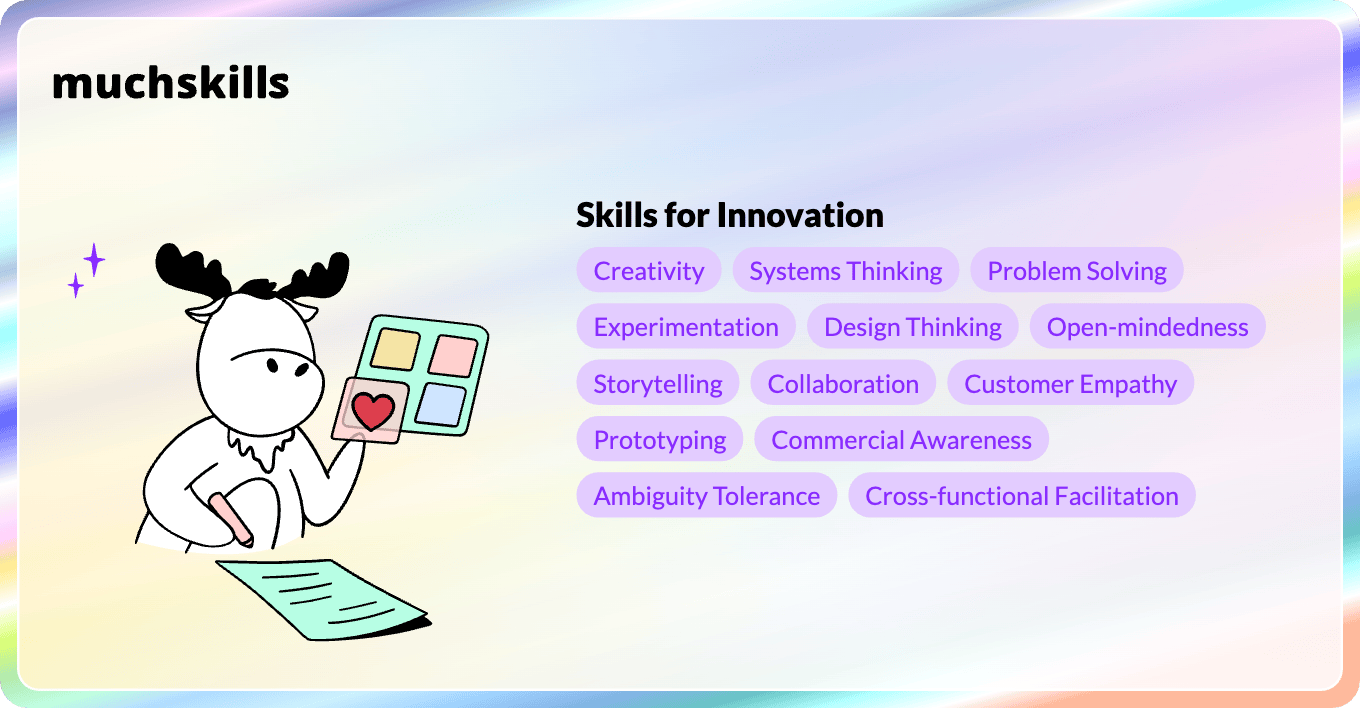
The complete skill set for innovation ability — priority skills, creative capabilities, and human skills. Map and track them with MuchSkills.
Skills and technical tools added by professionals on MuchSkills globally
Network engineering skills tracked across teams in the MuchSkills platform
More likely to place talent effectively — skills-based organisations vs traditional role-based ones (Deloitte)
Innovation Ability Skills: The Complete Overview
Innovation ability is not a personality trait — it's a skill set that can be identified, developed, and tracked. Yet most organisations have no structured view of where innovation capacity actually exists in their teams. MuchSkills gives HR and leadership the visibility to map, track, and develop innovation skills across their organisation.
When organisations treat innovation as something that either exists or doesn't, they miss both where it's already present and where it can be built. A structured skills framework makes it possible to identify where creative and strategic capability is concentrated, where it's absent, and what development investment would have the most impact.
Core priority skills for innovation ability
The skills most consistently prioritised for innovation include Creativity and Innovation, Entrepreneurial Spirit, Strategic Thinking, Business Acumen, Proactive, and Design Thinking. These represent the capabilities that define innovation-ready individuals — not just in ideation, but in execution, iteration, and commercial judgement.
Design thinking and methodology
Innovation competence is closely tied to structured approaches. Design Thinking stands out as a cross-functional methodology that combines empathy, ideation, and rapid prototyping — making it one of the highest-value skills to track in teams tasked with developing new products, services, or processes.
Essential human skills and global competencies
The human skills most central to innovation include Creativity and Innovation, Entrepreneurial Spirit, Strategic Thinking, Proactive orientation, and User & Customer Centricity. These determine whether someone can not only generate ideas but evaluate them, advocate for them, and adapt them in response to feedback.
Mapping innovation skills across your organisation
Understanding where innovation skills exist — and at what proficiency level — is the starting point for building high-performing product, design, and strategy teams. Why soft skills matter is particularly relevant here — innovation capability is almost entirely behavioural, which means it's both harder to see without a structured view and more likely to be overlooked in favour of technical credentials. MuchSkills maps the full innovation skill set across individuals and teams, giving leaders and HR a continuously updated view of real creative and strategic capability — and giving skills development for HR & L&D teams the data they need to build innovation capacity deliberately rather than hoping it emerges.
Frequently asked questions
What are the most important skills for innovation?
The most important innovation skills span both creative and strategic capabilities. Core skills include Creativity and Innovation, Entrepreneurial Spirit, Strategic Thinking, Design Thinking, and User & Customer Centricity. The right balance depends on role context, but these form the foundation of what high-performing innovators consistently demonstrate.
How do organisations track innovation skills effectively?
Effective innovation skills tracking requires more than qualitative assessments or hiring instinct. Organisations that maintain accurate visibility use a dedicated skills platform that captures specific skills and proficiency levels, updated continuously rather than only during annual reviews. This makes it possible to identify where innovation capacity exists and where to invest in development.
What is the difference between creativity and innovation as skills?
Creativity refers to the ability to generate novel ideas and approaches. Innovation extends this to include execution — the ability to move from idea to implemented change that creates value. Both are skills, and both can be assessed and developed. In a skills matrix, they're usefully tracked separately because they require different development paths.
Which innovation skills are most in demand right now?
Design Thinking, AI-assisted ideation, and cross-functional collaboration skills are increasingly expected in roles that touch product, strategy, or customer experience. Entrepreneurial Spirit — the ability to act on an idea with minimal resources — is also gaining prominence as organisations look for ways to move faster without adding headcount.

Subscribe to our newsletter