


The AI skills gap: Why most organisations don't know what they're missing
Every leadership team is asking some version of the same question right now. For a consulting firm, it arrives from a client: "Do you have AI and machine learning capabilities on your team?" For an HR Director, it comes from the CEO: "Are we AI-ready?" For a head of L&D, it shows up as a budget request for AI training with no clear sense of where to start.
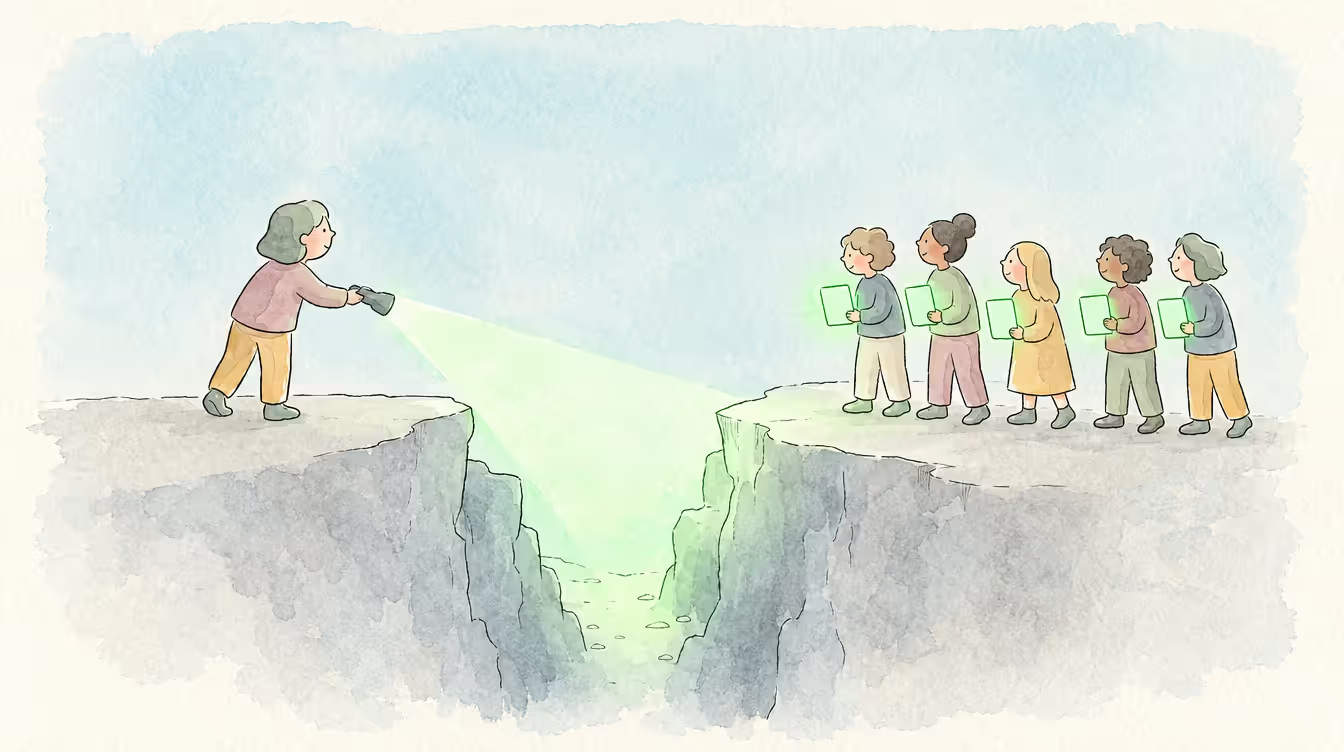
The question is reasonable. The problem is that most organisations are trying to answer it without the information they need. They know AI matters. They do not know, with any precision, what AI capabilities currently exist in their workforce — who has them, at what level, and who is actively developing them. Before the gap can be closed, it has to be seen. And seeing it clearly is harder than it looks.
'AI skills' is not one thing
The first obstacle is definitional. AI skills covers a spectrum so wide that treating it as a single category produces analysis that is too vague to act on.
At one end is foundational AI fluency — understanding how large language models work, knowing how to prompt effectively, being able to evaluate AI output critically rather than accepting it unchecked. This is relevant across almost every function and role. A marketer, a finance analyst, and a project manager all benefit from it, though what it looks like in practice differs significantly for each.
In the middle sits applied AI competency — using AI tools within a specific domain to produce better outputs faster. A data analyst working with Python libraries, a developer integrating AI APIs into products, a consultant using AI to synthesise large volumes of research. The skill here is not just knowing the tool exists but being able to deploy it effectively in context.
At the technical end sits AI engineering and development — building models, fine-tuning them, understanding the architecture, working with training data. This is specialist capability. Most organisations need far fewer people with it than they think, and most AI skills gap conversations conflate it with the broader fluency problem, which leads to both over-hiring for technical roles and under-investing in the applied competency layer that most of the workforce actually needs.
Understanding which part of the spectrum an organisation needs — and in what volume — is the prerequisite to any useful gap analysis. Organisations that skip this step end up investing in training that does not match the actual need, or recruiting for roles that are not the bottleneck.
The visibility problem that comes first
Assume an organisation has done the definitional work and knows what AI capabilities it needs. The next question is: what does it currently have?
This is where most organisations run into a structural problem. AI capabilities are developing faster than the systems organisations use to track them. Microsoft and LinkedIn's research found that 68% of the skills required to perform most jobs will change by 2030 as a result of generative AI — and that pace means skills are accumulating in the workforce well ahead of any organisation's ability to capture them systematically. People are building AI fluency through side projects, personal experimentation, online courses taken on their own time, and day-to-day work with tools they adopted without formal training. None of that shows up in an HRIS. Very little of it appears in a performance review. Most of it lives in people's heads and on their personal LinkedIn profiles — visible to recruiters outside the organisation but not to the managers and HR teams inside it.
The result is a paradox that most organisations are living through without naming it. They believe they have an AI skills gap. They may simultaneously have people with exactly the capabilities they need — developers experimenting with LLMs, analysts building Python scripts, consultants who have been using AI tools on client projects for eighteen months. This is shadow upskilling: capability accumulating in the workforce through personal experimentation and self-directed learning, entirely invisible to the managers and HR teams who need to know it exists. The gap is real, but its shape is unknown. And an unknown gap cannot be closed strategically. It can only be responded to reactively — through expensive external hiring, blanket training programmes that miss the actual need, or both.
Only 10% of HR executives say they can effectively anticipate future skills needs, according to Deloitte's research. That figure is not surprising given that most organisations do not have a reliable, current picture of the skills they already possess. You cannot anticipate what you need next if you do not know where you are starting from.
Why existing data sources don't solve this
The instinct, when this problem is named, is to look for the data in existing systems. Most organisations have several places where skills information theoretically lives — the HRIS, the performance management system, the LMS completion records, the CVs on file from when people were hired.
None of these sources gives a reliable answer to the question "what AI skills does this person actually have, and at what level?"
HRIS records capture job titles and employment history, not capability. Performance reviews record outcomes and behaviours, not the specific skills that produced them. LMS completion records are a vanity metric — they show that someone watched a course on machine learning, not whether they can apply it. CVs reflect what people chose to highlight when they were looking for a job, not what they have developed since.
The gap between what organisations know about their workforce and what they actually need to know is not a data volume problem. Most organisations are swimming in HR data. It is a data quality and structure problem — the information that exists is not organised around skills at the level of specificity needed to answer operational questions.
This is the infrastructure problem that precedes the AI skills gap problem. Before an organisation can understand its AI capability position, it needs a skills layer — a structured, current, searchable map of what every person in the organisation can actually do, at what proficiency, and in which direction they want to develop.
See how MuchSkills builds that skills layer →
The motivation dimension
There is a second dimension to the AI skills gap that rarely appears in the conversation about it: not just who has AI capabilities, but who wants to develop them.
This matters for two reasons. The first is practical — an upskilling programme built around people who are genuinely motivated to develop AI skills will produce better outcomes than one applied uniformly across a team. Motivation is not a soft variable. It is a predictor of whether development investment produces lasting capability or short-term compliance.
The second reason is strategic. The organisations that will build genuine AI capability over time are the ones that can identify the people already leaning into AI on their own — the ones experimenting, curious, building skills without being asked to — and give them the conditions and the recognition to go further. Those people exist in almost every organisation. Finding them is a visibility problem.
In MuchSkills, this is captured through Skill Will — a layer that sits alongside the standard proficiency rating and records, for each skill a person has, whether they actually want to use it. A consultant might have Python, data visualisation, and stakeholder management on their profile — Skill Will surfaces which of those they want to be deployed on. In an AI skills context, that distinction matters: it tells you not just who has the capability but who is genuinely motivated to use it. That combination shapes both who you deploy on AI-related work now and who you invest in developing for the future.
What closing the gap actually requires
An organisation that has done the visibility work — that has a current, structured, searchable map of its AI capabilities across the workforce — is in a fundamentally different position from one that has not. It can answer the client's question about AI capabilities in seconds rather than days. It can design an upskilling programme around the actual gaps in its specific workforce rather than a generic AI training curriculum. It can identify the people already developing AI skills and give them a path rather than losing them to organisations that will.
For consulting firms, this visibility gap has a direct commercial consequence. When a client asks whether the firm has AI-capable consultants for a project, the answer needs to come from a reliable source — not from a round of internal emails and a CV file that has not been updated since the consultant was hired. Firms that can answer that question accurately and quickly win work. Firms that cannot default to "we'll get back to you" — and often lose the bid before they do. See how MuchSkills works for consulting firms.
The starting point is that skills layer. Before strategy, before training budget, before hiring plans — an organisation needs to know what it is working with. That means building profiles that capture AI skills at the right level of granularity, on a scale specific enough to distinguish between someone who has completed an introductory course and someone who is production-ready, and keeping those profiles current as the capability landscape shifts.
MuchSkills has more than 12,000 technology skills in its database — including AI, machine learning, Python, LangChain, prompt engineering, and the specific tools and frameworks that matter for different roles. The AI Super Search allows a resource manager or HR leader to find everyone in the organisation with a specific AI skill combination — at a defined proficiency level, available now — in seconds rather than hours. That is what the answer to "do we have AI skills?" actually looks like in practice.
For organisations that want to understand the workforce planning dimension of this — how skills intelligence becomes the data layer for AI-driven workforce decisions — the AI workforce planning post covers the strategic picture. And if the gap analysis methodology is the next question, the skills gap analysis playbook provides a structured approach to identifying, prioritising, and closing capability gaps.
Frequently asked questions



What is the AI skills gap?
The AI skills gap is the difference between the AI capabilities an organisation needs and what its current workforce actually possesses. It is not a single gap — it covers a spectrum from foundational AI fluency relevant to most roles, through applied AI competency in specific functions, to specialist AI engineering capability. Organisations that treat it as a single problem tend to invest in the wrong solutions.
How do you identify an AI skills gap in your organisation?
Identifying an AI skills gap starts with two questions: what AI capabilities does the organisation need, and what does it currently have? The first requires clarity about which parts of the AI skills spectrum matter for which roles. The second requires a current, structured skills inventory — not CVs or HRIS records, but a live map of what people can actually do and at what proficiency. Without that baseline, gap analysis produces general observations rather than actionable findings.
Why is it hard to close an AI skills gap?
The most common reason is that organisations lack a clear enough picture of their starting point. Training programmes designed without reliable skills data tend to be too broad, missing the people who need them most and including people who do not. A second common failure is ignoring the motivation dimension — investing in AI upskilling for people who have no interest in developing in that direction, while missing those already building AI skills independently.
How quickly are AI skills changing?
Faster than most skills inventories can keep up with. Microsoft and LinkedIn's research found that 68% of the skills required to perform most jobs will change by 2030 as a result of generative AI. A skills inventory that accurately captured AI capability eighteen months ago is already significantly out of date. Organisations that rely on periodic audits rather than continuously updated profiles will always be working from a lagging picture.
Understanding your AI skills position starts with knowing what your workforce can actually do. See how MuchSkills maps skills across your organisation — and makes that picture searchable — on the HR and L&D solution page.


Ready to see what your teams can do?
MuchSkills turns the skills scattered across CVs, spreadsheets and heads into one living map — so staffing, planning and development decisions start from evidence, not guesswork.