How to create a skills-based organisation
A practical playbook to help your people grow and your business evolve – powered by MuchSkills.
Introduction:
Modern work moves fast. Traditional organisational structures don’t.In most organisations, people’s skills – the very foundation of performance – remain largely invisible. Companies hire people for their capabilities, yet very few can clearly see the skills that already exist across their teams. The result is what we call the skills fog: a lack of skills visibility that limits growth, wastes potential, and slows transformation.
Becoming a skills-based organisation means clearing that fog. It’s about understanding your people’s abilities in detail, aligning them with your business needs, and using those insights to plan, grow, and deliver with confidence. When organisations make this shift, they unlock measurable improvements in productivity, engagement, and agility.
Why this playbook exists
We created this playbook to guide you – step by step – through the transformation into a skills-based organisation. It is based on the MuchSkills Transformation Methodology, a research-driven framework that helps organisations:
- Map and validate workforce skills, competencies, and certifications.
- Turn visibility into action through data-led staffing, development, and workforce planning.
- Build engagement and internal mobility by aligning people’s strengths to meaningful work.
- Use real-time skills intelligence to guide strategic decisions.
This isn’t a theory paper. It’s a practical roadmap based on hundreds of real-world implementations – from consulting firms optimising utilisation to compliance-driven organisations achieving audit-ready certification tracking.
What you’ll learn
Across the next sections, you’ll discover:
- Why skills visibility matters – and how the skills fog is costing you more than you think.
- The business case for a skills-first approach, backed by global research.
- The MuchSkills Methodology – six practical steps to build your skills-based organisation.
- How to measure success and sustain continuous development.
- How to get started with MuchSkills in your own organisation.
Before you begin, a note: becoming a skills-based organisation isn’t about replacing people processes. It’s about giving HR, L&D, and organisational leaders the skills data they need to make confident, fair, and future-ready decisions.
With MuchSkills, you gain a clear, actionable view of your organisation’s collective capabilities – and a proven path to transform that insight into measurable business impact.
Section 1: The case for change – From skills fog to skills clarity
Most organisations operate in a skills fog. Ask any leader why they hire people, and the answer is always: skills. But ask those same leaders what skills currently exist across their organisation today and where the gaps are – and few can answer with confidence.
This disconnect has a cost. Despite years of investment in HR systems and learning tools, many organisations still lack a reliable, organisation-wide view of what their people can actually do. Job titles and CVs reveal only part of the story, while critical capability data remains scattered across systems, trapped in silos, or simply invisible. The result is slow decision-making, inefficient staffing, and missed opportunities for growth. The fog is not just an inconvenience – it affects talent, delivery, and business performance.
The hidden cost of the skills fog
PwC’s Global Workforce Hopes and Fears Survey 2024 found that more than a third of workers believe they possess “hidden skills” – abilities not visible in their qualifications, job titles, or work histories – that remain untapped. Among employees likely to change jobs, half believe they have such hidden skills, and 76% believe it would be easy to find a role that uses their capabilities better.
Limited learning opportunities compound the problem. Roles exposed to AI are seeing skills change up to 25% faster than before. Yet fewer than half of workers surveyed by PwC said their employer provides adequate chances to develop new, career-relevant skills, and nearly 50% said access to learning strongly influences whether they stay or leave.
Beyond retention, the skills fog affects workforce planning, project staffing, utilisation, and long-term capability development.
The symptoms of the skills fog
The problem becomes easy to recognise once you know what to look for. You may already see these symptoms in your organisation:
- Job titles do not reflect real capability. Two people with the same job title can have completely different skills and strengths.
- L&D efforts lack direction. Training budgets are spent without clarity on which skills genuinely need development.
- Managers guess, not plan. Teams are staffed based on availability or instinct rather than verified capability.
- Employees feel unseen. They don’t know which of their skills matter – or how to grow into new roles.
- Leaders lack data. Workforce planning becomes reactive instead of proactive.
The scale of the challenge
- 53% of HR and business leaders cite insufficient skills data as the top barrier to workforce readiness. (i4CP, Accelerating Workforce Readiness).
- Only 18% of organisations maintain an employee skills database – and just 10% cover all employees. (i4CP, Accelerating Workforce Readiness).
- Only 23% of organisations use workforce analytics to predict skills gaps. (PwC, Future of Work and Skills, 2021)
- More than a third of workers say they have skills not visible from their qualifications, job history or job title. (PwC, Global Workforce Hopes and Fears Survey, 2024).
- Nearly two out of three projects fail to reach full success due to poor staffing choices. (Chaos Report, 2020)
Together, these findings show a global problem: organisations know skills matter, employees want to use their “hidden” skills at work, but few companies have the systems or processes to manage them effectively.
“It’s imperative that businesses make investments in systems that inventory and maintain an inventory of current skills and that support visualisation of gaps in future skills.”
– PwC, Future of Work and Skills Survey, 2021
Why traditional structures can’t keep up
Roles and required skills now change faster than job descriptions, frameworks, or competency models can be updated.
A “marketing manager” in 2015 didn’t need to understand AI analytics or automation workflows – today they do.
Traditional structures optimised for static roles struggle to reflect how work actually operates now: through projects, cross-functional teams, and rapidly-evolving skill sets.
As a result, instead of planning for future capability, many organisations are still optimising for roles that no longer exist.
Skills-based organisations work differently
The difference between traditional and skills-based organisations is clear. Skills-based organisations replace guesswork with insight. Here’s how they differ from traditional organisations:
Skill-based organisations see people not just for the roles they fill, but for the skills, strengths, and ambitions they bring to the table.
The cost of staying in the skills fog
Without a clear view of workforce capabilities, organisations risk:
- Underutilisation: Valuable skills go unnoticed or unused.
- Project delays: Poor staffing decisions create delivery risk.
- Lower engagement: Employees can’t see growth opportunities.
- Wasted investment: Training and hiring decisions lack data.
- Strategic blind spots: Leaders can’t forecast future capability needs.
In short: the skills fog slows everything down – decisions take longer, opportunities are missed, and performance suffers.
The opportunity ahead
The good news is that the fog can be cleared. When organisations make skills visible, they unlock a faster, fairer, and more effective way to grow.
Modern skills intelligence systems and structured methodologies now make it possible to see every employee’s capabilities, align them with business strategy, and use that clarity to drive both individual and organisational growth.
Without this foundation, attempts to become skills-first organisations will stall before they begin. With it, they can plan confidently, act decisively, and build a workforce ready for what’s next – for any workplace transformation.
That’s exactly what the MuchSkills Methodology does: It helps organisations turn skills visibility into business impact.
Section 2: The business case – Why skills-based organisations outperform
Making skills visible pays off.
Skills-based organisations don’t just know what people can do, they use that knowledge to place the right talent in the right roles at the right time. Once organisations start mapping and using their people’s real capabilities, the results are striking. Research consistently shows the performance advantage:
Skills-based organisations are:
- 107 % more likely to place talent effectively
- 98 % more likely to retain top performers
- 57 % more likely to anticipate and respond to change
- 52 % more likely to innovate
(Deloitte – Building Tomorrow’s Skills-Based Organisation, 2022) - Firms that align people to roles matching their skill profiles are significantly more productive, with management quality as the deciding factor. (Centre for Economic Policy Research – CEPR)
Taken together, these findings point to a clear pattern across industries: when organisations understand and leverage their people’s skills, they unlock higher engagement, better delivery, faster transformation, and improved profitability.
Why it works
A skills-first model strengthens the three performance levers most organisations struggle to manage effectively:
- Talent allocation: Teams are staffed by skill and readiness, not job title or tenure, reducing delivery risk and improving project success rates.
- Growth and retention: Employees can see how their skills connect to opportunity. Clear paths for development increase motivation, mobility, and loyalty.
- Strategic agility: Leaders can reallocate capability to new initiatives in weeks, not quarters because they understand the organisation's real strengths.
By making skills a shared language across HR, L&D, and operations, organisations move from anecdotal decision-making to data-driven talent deployment.
What leaders gain
A winning equation
Skills intelligence = better decisions + faster delivery + happier people.
Becoming a skills-based organisation isn’t just an HR transformation.
It’s a business strategy that directly improves performance metrics every executive cares about – productivity, profitability, and growth.
So how do organisations used to doing things the old way adopt the skills-based approach?
In the following section, we’ll unpack the MuchSkills Transformation Methodology – six practical steps to move from skills fog to full skills intelligence.
Section 3: The MuchSkills Methodology: From skills visibility to business impact
So how can organisations make this shift in practice?
Becoming a skills-based organisation doesn’t happen overnight. It requires accurate data, thoughtful system design, and a culture that values transparency and growth. The MuchSkills Methodology provides a clear, proven framework for this journey. It turns the abstract idea of “skills visibility” into a practical roadmap for workforce transformation.
Built from hundreds of real-world implementations, it helps organisations see, understand, and activate their people’s skills in six practical steps. Each step combines human-centred change with data-driven decision-making – so every investment in skills directly supports business performance and, over time, drives wider workplace transformation.
The six steps to building a skills-based organisation
Why it works
The MuchSkills Methodology works because it balances structure with flexibility. It gives leaders a clear sequence to follow while allowing every organisation to adapt the approach to its own strategy, systems, and culture.
Each step builds on the last – moving from visibility to action, from growth to intelligence. By the end of the journey, organisations shift from asking, “What skills do we have?” to confidently answering, “Do we have the right skills for what’s next?”
But a skills-based organisation cannot be built through technology alone. Data creates visibility; people create change. That’s why MuchSkills supports the human side of transformation too – through change-management guidance, onboarding workshops, and manager training that help new behaviours take root.
Employees learn to own their growth.
Managers learn to coach with data.
Leaders gain the insight to plan with confidence.
Together, these elements turn skills visibility into measurable business impact. The MuchSkills Methodology doesn’t just show what transformation looks like – it helps organisations sustain it.
In the next section, we explore what success looks like in practice: a future where skills visibility drives engagement, growth, and profitability across the organisation.
Section 4: ‘I can see clearly now’: What a world without skills fog looks like
When the MuchSkills Methodology is fully embedded, something powerful happens: people start working in ways that feel both more human and more effective.
- Managers stop making decisions in the dark.
- Employees understand how their strengths create impact.
- Leaders gain a real-time view of capability – not through annual reports but through live intelligence that informs every project, initiative, and strategy.
When the skills fog lifts, clarity replaces guesswork, and every layer of the organisation becomes more confident and connected.
For employees: growth with clarity
Skills visibility transforms the employee experience. When people understand how their skills link to opportunity, development stops being a mystery and becomes a shared, transparent shared process.
Gallup’s research shows that employees with access to development opportunities are 3.6 times more likely to be engaged. But that clarity is still rare. Gallup’s State of the Global Workforce 2025 shows that only 21% of employees worldwide – and just 13% in Europe – are engaged at work, a reminder of how much potential is lost when organisations fail to make skills visible.
With MuchSkills, employees can:
- Build a complete, visual picture of their skills and strengths.
- Compare their profile against any role in the organisation.
- Set and track personal development goals linked to real business needs.
- Be discovered for projects that match their skills and interests.
The result is a workforce that grows faster, feels more valued, and works with a greater sense of purpose
Customer insight
“It [MuchSkills] enables transparent, data-driven decision-making when it comes to people allocation, upskilling, and hiring. The management dashboard gives valuable insights into skill distribution and highlights both opportunities and gaps. We've seen a cultural shift toward proactive skills development, especially with the skill gap analysis and growth path assessments.”
- Oleg B, Head of Engineering
For managers – clarity and confidence
Visibility empowers not only employees but also the people who lead them. Managers lead better when they understand what their teams can actually do. Instead of relying on intuition or outdated spreadsheets, managers gain real-time insight into skills, certifications and development goals. This enables them to:
- Build balanced teams for upcoming projects.
- Run more meaningful one-on-ones focused on growth.
- Spot underutilised talent before it disengages.
- Track development progress without additional admin.
Managers become coaches and talent multipliers – able to help every individual contribute their best.
Customer insight:
“MuchSkills has become a key part of how we approach talent development in our agency. It helped us map the skills of our staff in detail and identify areas for upskilling and reskilling. Teams like Operations and Sales now have visibility into people’s capabilities and can make better-informed decisions.”
– Gonzalo M., VP of Technology Enablement, Marcus Thomas
For HR and L&D – strategy with evidence
Skills intelligence gives people leaders measurable data to design programmes that actually move the needle. This means that L&D stops being reactive and HR stops relying on anecdotal evidence.
Using MuchSkills, HR and L&D teams can:
- Map organisational capability at every level.
- Pinpoint skills gaps and direct learning investment.
- Monitor certification compliance and upskilling progress.
- Report capability growth and workforce readiness to leadership.
This becomes the foundation of a truly skills-first talent strategy – one where development plans, succession pipelines, and hiring priorities are all grounded in real data.
Customer insight:
“The [MuchSkills] system is flexible and powerful, and it has been successfully adapted to align with our organisation’s workflows and culture. I'm confident that as the platform continues to evolve, it will become an even more integral part of how we manage and develop skills within our team.”
– Victoria L., Global HR Manager, Harald Pihl
For leadership – insight that drives performance
The same visibility that empowers employees and managers also transforms how leaders make decisions.
When capability data is transparent and trusted, leadership planning becomes more precise and more strategic.
With MuchSkills, leaders can:
- Forecast skills demand for future projects and markets.
- Identify where capability risks threaten delivery.
- Align workforce strategy with corporate objectives.
- Track ROI on development, staffing, and hiring initiatives.
Leaders move from reactive management to proactive workforce design – ensuring the organisation is always ready for what’s next.
Customer insight:
“We implemented MuchSkills several years ago to better understand and develop workforce capabilities – and now our learning data is part of our annual strategy reporting. The AI-powered insights aligned to our HR goals help us scale smarter every year.”
– Anniken Fischer, Talent & Performance Manager at Höegh Autoliners, a leader in sustainable heavy-cargo shipping
The organisation as a whole – connected, agile, and future-ready
When everyone can see and use skills data, collaboration becomes fluid.
Expertise flows to where it is needed. Teams form faster. Delivery risk decreases.
In a skills-based organisation:
- Employees are more engaged, grow faster, and stay longer.
- Managers build stronger, more balanced teams.
- HR and L&D lead with measurable results.
- Leadership plans with precision and confidence.
Every layer of the organisation becomes connected by a single, living skills infrastructure – a shared understanding of who can do what, where the gaps are, and how to close them.
That is the real outcome of becoming a skills-based organisation:
clarity, alignment, and measurable growth.
But what are the tools that can help bring a skills-based organisation to life?
Section 5: Tools and technology that make it possible
From insight to infrastructure
Skills clarity doesn’t happen on its own. Behind every skills-based organisation is a solid foundation: tools that make skills visible, measurable, and actionable. Without the right technology, the process quickly breaks down – spreadsheets go stale, data silos appear, and confidence in the information fades.
The MuchSkills platform provides that foundation. It acts as the skills intelligence layer across the organisation – connecting people data, project data, and learning data into one living system of record.
This is where the transformation becomes real: when every employee, manager, and leader can see, use, and act on accurate skills information in real time.
The MuchSkills platform at a glance
MuchSkills isn’t another HR database or learning management system.
It is the connective tissue that links your people’s skills and competencies to business outcomes.
The platform brings together five integrated pillars – each aligned to a stage of the transformation methodology.
1. Skills Intelligence – Build clarity
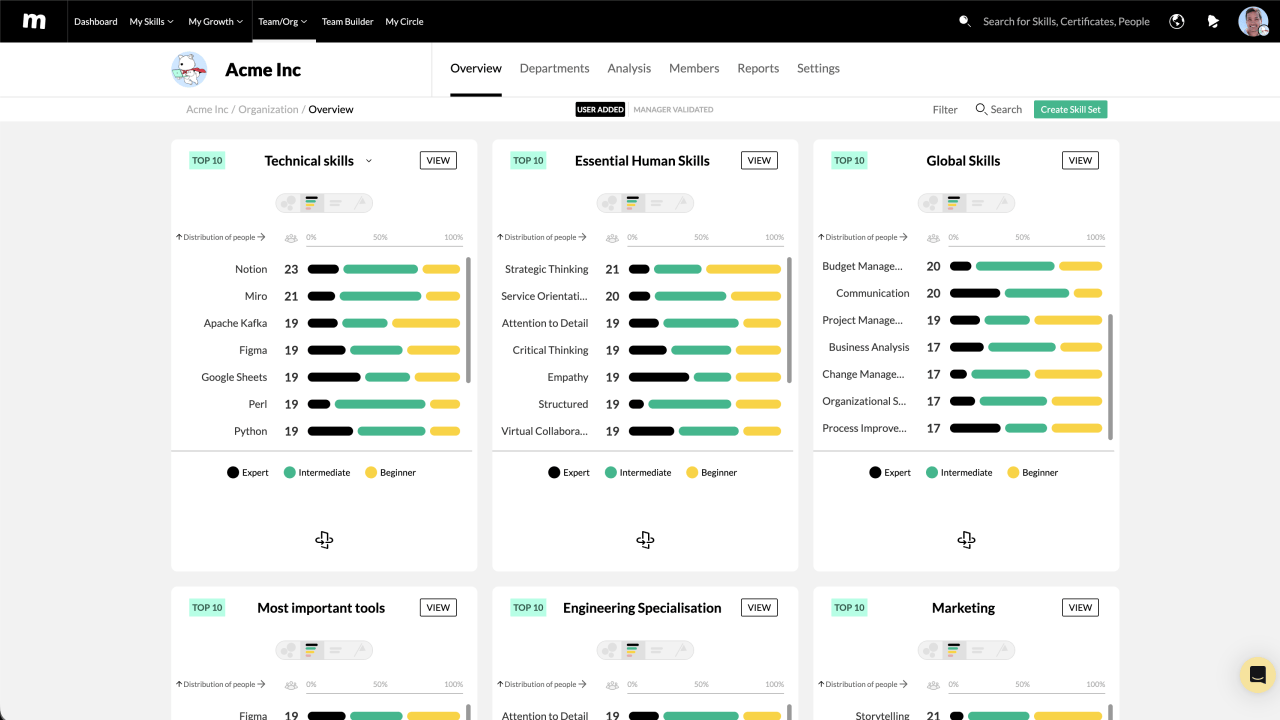
Map the capabilities that drive your organisation. Employees log their skills using a simple, bias-reducing 3×3 proficiency scale, while the organisation defines which skills matter most. The result is a living skills architecture that is both structured and human-centred.
The MuchSkills platform enables:
- Organisation-wide visibility of skills, certifications, and proficiencies.
- Searchable employee profiles that make expertise easily discoverable.
- Consistent, standardised skill taxonomies across teams, departments, and roles (import existing taxonomies or build from scratch).
Outcome: A single trusted source of truth that replaces scattered skills data with real workforce intelligence.
2. Smart Resourcing – Match the right people to the right work
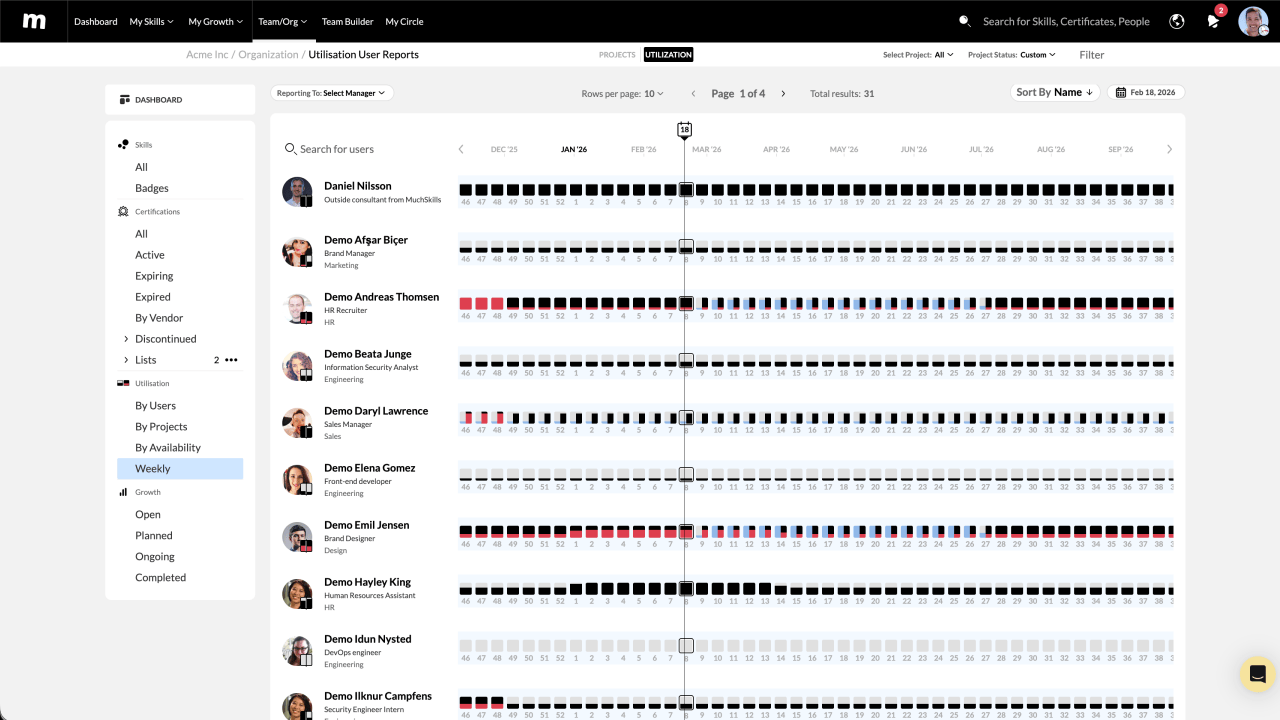
MuchSkills bridges the gap between capability and delivery. Using tools like Team Builder and CV Inventory, organisations can staff projects with precision, showcase expertise in proposals, and reduce costly bench time.
MuchSkills enables:
- Fast team assembly based on verified skills, certifications, and availability.
- Automated, client-ready consultant profiles for bids and proposals.
- Real-time visibility of utilisation and workload across teams.
Outcome: Higher project success rates, improved profitability, and reduced delivery risk.
3. Certification & validation – Maintain trust and compliance
Skills data is only powerful when it’s trusted. MuchSkills offers multi-layered validation that combines employee transparency, manager review, and certification tracking. For regulated industries, this ensures full audit-ready compliance.
MuchSkills enables:
- Validation workflows for skills, competencies, and badges.
- Certification tracking with expiry alerts and audit logs.
- Clear visibility of compliance coverage by role, team, or site.
Outcome: Verified, audit-ready skills data that supports operational reliability.
4. Personalised development – turn visibility into growth
Every employee receives a role-based gap analysis and can create individual development goals linked directly to organisational needs. Managers and L&D teams design tailored learning paths, connect them to internal or external learning resources, and track progress over time.
MuchSkills enables:
- Clear role-to-skill comparisons
- Personalised growth plans tied to business priorities.
- Transparent progress tracking for individuals and teams.
- Alignment between learning investments and skill priorities.
Outcome: Development becomes targeted, measurable, and motivating.
5. Strategic insights – Plan with precision
Once skills data is structured, MuchSkills turns it into intelligence.
Leaders can view skill and capability heatmaps, forecast skill gaps, monitor utilisation, and align workforce planning to strategic priorities – all from one dashboard.
MuchSkills enables:
- Organisation-wide analytics on skills, growth, and readiness.
- Forecasting of skill demand, bench availability, and role readiness.
- Early identification of capability risks affecting delivery or compliance.
Outcome: Informed, forward-looking decisions that link people capability directly to business performance.
The ecosystem advantage
MuchSkills integrates seamlessly with your existing systems – HRIS, LMS, CRM, BI, and project-management tools – through an open API. This ensures that skills data flows securely between workflows, rather than getting trapped in silos, creating a unified, always-current view of the workforce.
Typical integrations include:
- HRIS (e.g., Workday, SAP SuccessFactors, Personio) – employee data synchronisation.
- LMS (e.g., 360Learning, LinkedIn Learning) – learning outcomes and certification updates.
- CRM & project tools (e.g., HubSpot, Jira, Asana) – staffing and project alignment.
- BI platforms (e.g., Power BI, Tableau) – advanced reporting and dashboards.
With MuchSkills as the central layer, skills data becomes part of daily operations – not another system to manage, but the one that connects everything else.
Built for scale and security
MuchSkills is designed for modern organisations – secure, EU-hosted, and built to scale.
Role-based access controls ensure sensitive data is visible only to authorised users.
Multi-instance architecture supports complex enterprise structures, regions, or business units.
High-performance infrastructure supports organisations from 50 employees to 50,000. This combination of flexibility, compliance, and scalability makes MuchSkills effective for organisations of all sizes.
Section 6. Measuring progress – What success looks like
Turning transformation into measurable impact
A skills-based organisation – like any workplace transformation – isn’t built in a single rollout. It evolves in stages, as data quality improves and behaviours change.
That’s why measurement matters. Tracking the right indicators from the start helps organisations demonstrate progress, fine-tune their approach, and prove tangible ROI to both leadership and employees.
MuchSkills enables this with live dashboards and clear metrics that show how skills visibility drives real-world results.
Three levels of measurement
To understand whether your transformation is working, measure success at three levels:
- Data quality – Are your skills mapped, verified, and kept up to date?
- Behavioural adoption – Are managers and employees actively using skills data to guide decisions?
- Business outcomes – Is skills visibility improving productivity, engagement, and delivery?
1. Data quality – Build the foundation for trust
A skills-based transformation starts with trusted data. Without confidence in the information, people won’t use it – and the system won’t drive change.
Key metrics to track:
- Profile completion rate: % of employees who have created or updated their skills profile.
- Validation coverage: % of skills validated by a manager, peer, or certification.
- Profile freshness: % of profiles updated in the last 3-6 months.
- Certification accuracy: % of active certifications with valid expiry dates logged.
When skills data is current and validated, it becomes a reliable foundation for every HR, L&D, and operational decision.
2. Behavioural adoption – From system use to culture shift
Once the data foundation is strong, the next question is: Are people actually using it?
Success at this stage is not about system log-ins. It’s about meaningful behavioural change – skills data becoming part of everyday conversations, reviews, staffing, and planning.
Key metrics to track:
- Manager usage rate: % of managers using skills insights in one-on-ones or performance reviews.
- Goal-setting engagement: % of employees with active development goals linked to skill gaps.
- Internal mobility: Number of employees moving into new roles or projects based on skills data.
- Training alignment: % of learning activities directly tied to identified skill needs.
A cultural shift happens when “What skills do we have?” becomes a daily operational question, not a quarterly report.
3. Business outcomes – Connecting people to performance
Ultimately, skills visibility should improve performance across the organisation. Once skills data is consistently used, its impact becomes visible in productivity, engagement, and delivery quality.
Key metrics to track:
- Utilisation rate: % of total workforce time spent on billable or strategic work.
- Project success rate: % of projects delivered on time and within budget.
- Engagement score: Employee engagement survey results, particularly around “growth and recognition.”
- Capability risk: Decline in critical skill gaps or certification expiries.
- Learning ROI: Improvement in role readiness or performance following development activities.
The goal isn’t to track everything – it’s to track what drives performance, engagement, and confidence across your teams.
A note on timeframes
Transformation takes time. Most organisations see measurable behavioural change within 3-6 months of rollout, and business-level results within 9-12 months.
Measurement helps maintain momentum. By tracking data quality, behavioral adoption, and business impact together, organisations can demonstrate progress and secure long-term commitment from leadership.
MuchSkills supports this journey with ongoing analytics, benchmarking, and periodic success reviews – helping you measure not just adoption, but continuous improvement.
In the next section, we’ll look at the lessons learned from hundreds of MuchSkills implementations that can help your organisation sustain progress and scale with confidence.
Section 7. Common pitfalls and how to avoid them
Building a skills-based organisation reshapes how people, processes, and technology interact. Even with the best intentions, transformation efforts can stall when foundations are overlooked or when tools are prioritised over culture. Once measurement begins (see Section 6), it becomes clear where momentum typically drops.
Based on hundreds of MuchSkills implementations, these are the most common pitfalls – and how to avoid them.
1. Treating it as an HR project instead of a business strategy
A skills-based approach touches sales, delivery, operations, compliance, and leadership – not only HR or L&D. When ownership sits in a single function, adoption slows and impact remains narrow.
Avoid it by:
- Positioning skills intelligence as part of the business strategy, not just a people initiative.
- Involving cross-functional leaders early to define the goals and success metrics.
- Linking the programme to outcomes such as project readiness, utilisation, customer impact, or risk reduction.
When everyone sees how skills data connects to their KPIs, engagement follows naturally.
2. Starting with the technology before defining the taxonomy
It is tempting to begin with software. But without a clear definition of which skills matter, even the best tools will produce noisy, inconsistent data.
Avoid it by:
- Defining or customising a skills taxonomy aligned to your strategy before rollout.
- Starting with critical roles or service areas, then expanding.
- Reviewing and updating the taxonomy quarterly to keep it relevant.
A clear, stable skills architecture is the foundation of trustworthy data.
3. Collecting data once – and never maintaining it
A one-off skills survey becomes outdated within months. People learn, grow, take on new work, and gain new expertise. If the system is not refreshed regularly, confidence in the data fades and usage drops.
Avoid it by:
- Embedding refresh prompts into one-on-ones, retrospectives, and employee development talks. These conversations are the primary mechanism for keeping skills data accurate – the most important process to get right. When every 1:1 includes a review of strengths, gaps, and recent skills changes, accuracy rises naturally.
- Scheduling formal, organisational-wide refresh cycles – every 3-6 months.
- Using automation to remind employees about profile freshness and expiring certifications.
When skills data is not continuously maintained, skills visibility degrades into a static snapshot.
4. Skipping validation
Self-reported skills are a great start but can create bias if left unchecked. Validation ensures credibility and helps managers coach more effectively. What matters is not validating everything, but validating the right things.
Some skills exist to support development conversations. Some exist for compliance. Others exist so you can identify talent quickly. Only a subset of skills truly need validation. Choose them intentionally.
Avoid this pitfall by:
- Agreeing which skills require validation and why.
- Using transparent peer comparison or manager review for priority skills.
- Linking validation to evidence such as certifications, delivered projects, or client feedback.
- Treating validation as a conversation, not an audit.
Trust in the data builds trust in the process.
5. Ignoring the human side of change
Technology adoption is easier than behavioural change. Even a well-designed system will feel like extra admin without communication, training, and early wins.
Avoid it by:
- Explaining the “why” – how skills visibility benefits employees as much as leadership.
- Training managers to integrate skills insights into coaching and staffing.
- Celebrating early wins and sharing success stories internally.
Adoption happens when people feel empowered, not monitored.
6. Measuring activity instead of outcomes
Tracking log-ins or profile creation won’t demonstrate value. What matters is the impact: faster staffing, reduced bench time, clearer development, improved retention.
Avoid it by:
- Defining outcome metrics before launch (see Section 6 for outcome metrics).
- Reporting progress in business terms, not system usage.
- Using dashboards to show how skills insights improve delivery, capability, and performance.
Outcome-focused measurement keeps leadership support strong.
7. Failing to connect systems
Skills data trapped in a single platform cannot inform the rest of the organisation. Disconnected systems create manual work, duplicate effort, and erode trust in the data.
Avoid it by:
- Integrating MuchSkills with HRIS, LMS, CRM, project tools, and BI dashboards.
- Ensuring leadership can see skills intelligence in the systems they already use.
- Using open APIs to keep skills data flowing across workflows.
Integration turns skills visibility into operational intelligence.
To sum up
Becoming a skills-based organisation is as much about discipline and culture as it is about software.
Define what matters. Maintain it continuously. Validate transparently. Connect it to the work people actually do. These principles separate a one-off initiative from lasting transformation.
Section 8. Real-world examples and case highlights
Every organisation’s workplace transformation journey to becoming skills-based looks different. But the outcomes share one theme: when people and leaders can finally see the skills across their teams, performance improves – fast.
Below are anonymised examples drawn from real MuchSkills implementations across consulting, regulated industries, technology, and the public sector.
Example 1 – Consulting firm: From bench time to billable time
A 600-person professional services firm struggled with inconsistent utilisation.
Project staffing relied on spreadsheets and manager intuition, leaving some consultants overbooked while others remained on the bench.
After implementing MuchSkills, the firm mapped every consultant’s verified skills and certifications and began staffing projects based on capability rather than job title. Team Builder and CV Inventory became part of daily operations.
Within six months the company reported:
- 20% reduction in bench time
- 3% increase in overall margin
- Faster RFP turnaround via automatically generated consultant CVs
The organisation improved both delivery quality and win rates by showing clients real capability – not assumptions.
Example 2 – Regulated manufacturer: Compliance under control
A global manufacturing group operating under ISO and ESRS standards faced repeated audit failures due to outdated certification tracking. Training records lived in spreadsheets, and renewal reminders often arrived too late.
By deploying MuchSkills’ Certification & Validation module, the organisation centralised certifications, expiry alerts, and validation workflows in one system. The results:
- Audit preparation time cut by 80%
- Zero expired certifications in critical operational roles
- Real-time visibility of compliance coverage by team and site
Managers can now anticipate compliance risks months in advance and assign retraining before issues escalate.
Example 3 – Technology company: development with direction
A fast-growing SaaS firm wanted to move beyond generic learning paths. Employees were completing courses, but the organisation struggled to connect learning activity to real readiness or performance.
Using MuchSkills’ Gap Analysis and Growth Goals, the company created role-based skill profiles and encouraged employees to set personalised development goals aligned to business priorities.
Within one year:
- 82 % of employees had active, tracked development plans
- Employee engagement increased by 12 points
- L&D linked learning investments directly to improvements in role readiness.
Skill dashboards are now used in every one-on-one, making development part of everyday work.
Example 4 – Public-sector agency: Data-driven workforce planning
A government agency with thousands of employees had no reliable view of capabilities across departments. Workforce planning was reactive, and critical skills were often concentrated in a few individuals.
After implementing MuchSkills across departments:
- 15,000+ employee skills were mapped in the first phase
- Hidden experts were identified and redeployed to priority initiatives
- Analytics highlighted future skill gaps tied to digital-transformation goals
Leaders now plan recruitment, mobility, and upskilling based on facts – not assumptions – improving both efficiency and transparency.
Common outcomes across all industries
Across sectors, organisations using MuchSkills typically report consistent improvements:
- Faster staffing and reduced project risk through verified skills data
- Improved utilisation and higher profitability in services environments
- Higher engagement and retention through visible, personalised growth paths
- Audit-ready compliance via automated validation and alerts
- Better strategic foresight, supported by analytics and capability forecasting
When organisations finally see their skills clearly, they act with confidence. MuchSkills turns that visibility into measurable business performance.
Section 9. Getting started with MuchSkills: From intention to action
Becoming a skills-based organisation starts with a simple commitment: to make skills visible. Once you can see what your people can do, every other step – staffing, development, planning, and compliance – becomes clearer and more effective.
The MuchSkills methodology gives you the structure. The platform provides the tools. Here’s how to bring both together and start your transformation with confidence.
Step 1 – Define your purpose
Clarify why you want to become a skills-based organisation. Are you trying to improve utilisation, reduce compliance risk, strengthen engagement, support mobility, or plan more effectively for future capability needs?
Define the outcomes that matter most to your leadership team – they will shape every decision that follows.
Tip: Keep your “why” measurable. For example:
- Increase project success rate by 10%.
- Improve employee development plan completion to 80%.
- Achieve 100% certification compliance across critical roles.
Step 2 – Start small, scale fast
Begin with one department, service line, or strategic initiative. Run a pilot with 50-200 users to map skills, validate data, and test internal workflows.
Use this phase to:
- Refine your skills taxonomy.
- Train managers on validation and goal-setting.
- Gather feedback and understand adoption drivers.
Within a few weeks, you’ll have real insights – and a success story to build momentum for broader rollout.
Step 3 – Connect your systems
Integrate MuchSkills with your existing HR, L&D, and project tools to keep skills data live and connected to daily workflows.
Typical integrations include:
- HRIS for employee profiles and organisational structure.
- LMS for learning outcomes and certifications.
- Project systems for staffing and utilisation data
- BI platforms for leadership dashboards and analytics.
Integration ensures that skills intelligence flows through operations rather than becoming another isolated system.
Once your systems are connected, the focus shifts to the people who will use them.
Step 4 – Train and empower managers
Managers are the bridge between visibility and action. When managers use skills insights in their conversations, staffing decisions, and goal setting, adoption spreads quickly.
Provide them with:
- Short onboarding sessions.
- Simple check-in templates linked to skills dashboards.
- Guidance on setting development goals tied to business needs.
When managers lead with data, employees follow their example and the transformation accelerates.
Step 5 – Communicate and celebrate
Transformation succeeds when people can see progress.
Share updates, quick wins, and impact stories across the organisation.
This reinforces behaviour change and builds trust in the process.
Examples of what to celebrate:
- Teams using skills data to deliver faster.
- Employees completing certifications or reaching growth goals.
- Improvements in utilisation, mobility, or project readiness.
- “Skills health” dashboards showing positive trends.
Visibility builds momentum. Momentum drives adoption.
Step 6 – Measure, refine, and expand
Use the metrics from Section 6 to track progress.
Revisit your skills taxonomy and data quarterly to ensure accuracy and relevance. Once your pilot shows measurable success, scale the model across departments or regions.
MuchSkills’ onboarding and success teams can support you through each stage – from taxonomy setup and refinement to advanced workforce analytics.
A clear path forward
Becoming a skills-based organisation isn’t about adding another system.
It’s about building a culture of clarity – where people understand their value, leaders make confident decisions, and the organisation grows with purpose.
Start small. Stay consistent. Use skills visibility as the engine of progress.
MuchSkills helps you see what your people can do – and what’s possible next.
Section 10. Resources and further reading
Continue your journey
Becoming a skills-based organisation is an ongoing evolution. Every step you take increases visibility, agility, and engagement. The resources below will help you deepen your understanding, benchmark your progress, and take practical next steps with MuchSkills.
MuchSkills guides and tools
- The MuchSkills Transformation Methodology – A detailed framework for moving from skills fog to full visibility and intelligence.
- Skills Taxonomy Guide – How to define and structure the capabilities that matter most to your business.
- How to Conduct a Skills Gap Analysis – A simple template to identify and close capability gaps.
- Manager Playbook: Leading with Skills Data – How to run better one-on-ones and build stronger, more balanced teams.
Each MuchSkills resource is designed to support you step by step as you build a skills-first organisation.
Other research and insights
These studies form part of the evidence base behind the MuchSkills methodology and reinforce why skills visibility and validation are critical to performance:
- Deloitte: Building Tomorrow’s Skills-Based Organisation, 2022.
- Gallup: State of the Global Workforce, 2025
- PWC: Global Workforce Hopes and Fears Survey 2024
- OECD: Better Use of Skills in the Workplace – Why it matters for productivity and local jobs (2017).
Together, they highlight the same message: skills-based organisations outperform because they understand their people and act on that intelligence.
Contact us
If you’re ready to begin your journey toward a skills-fog-free organisation, we’d love to help you get started.
- Book a demo: Explore how MuchSkills can support your teams.
- Contact: wow@muchskills.com | www.muchskills.com
Follow us on LinkedIn: Join the conversation on skills-based work and workforce transformation.
Subscribe to our newsletter
Create your skill matrix now
Book a 30-minute demo and we'll show you exactly what skills visibility and capacity planning looks like for a team like yours.