


Create custom skill categories
- Who
- An Owner or Admin
- Where
- Team/Org › Settings › Manage Skills
- Bulk upload
- CSV file, up to 100 skills per file
- Employees see it in
- My Skills
Custom skill categories hold the skills your organisation wants to map beyond the built-in ones, such as domain expertise, industries, services or the brands you work with. You create a category, add skills with descriptions, and decide who is offered each skill. Employees then pick from it in My Skills.
How it works
Every profile in My Skills has four built-in categories: Job Focus, Technical skills, Soft Skills and Certifications. Custom categories add your organisation's own sets of skills. Employees find them in My Skills under Skills my company wants me to specify, and pick the skills that apply to them.
Each category has a name, a description, an icon and a visualisation. Each skill in it has a description and the departments that are offered it.
| Visualisation | Use it for | How people fill it in | Example from the app |
|---|---|---|---|
| Sector Chart | Skills where expertise can be measured or compared | They rate each skill on the nine-step scale | Problem Solving, Project Management and Python |
| Bubbles | Things that can't be measured on a scale | They make a bubble bigger to show where their focus is | Work from home, Travel International or Games you like to play |
You choose the visualisation when you create the category. Sector Chart is the right choice for almost every category, because only rated skills can be compared and analysed by level, for example with a required level in a role list.
Before you start
- Role: Owner or Admin.
- Have your list ready. A skills taxonomy makes this much easier. See Build your skills taxonomy.
- Leave out software and programming languages. They belong in Technical skills, which already holds more than 12,000 of them.
- Set up departments first if some skills are only for some departments. See Manage departments.
Steps
Create the category
- Open Manage Skills. Go to Team/Org › Settings › Manage Skills.
- Click Create Skill Category. A form opens on the right.
- Name the category. Type a name, for example Domain Expertise. Click the image icon above the name to choose an icon.
- Describe it. Under Description, say in one or two sentences what belongs in this category. Employees see it in My Skills.
- Choose the visualisation. Under Visualisation Type, select Sector Chart or Bubbles.
- Click Save and continue. The new category opens, ready for skills.
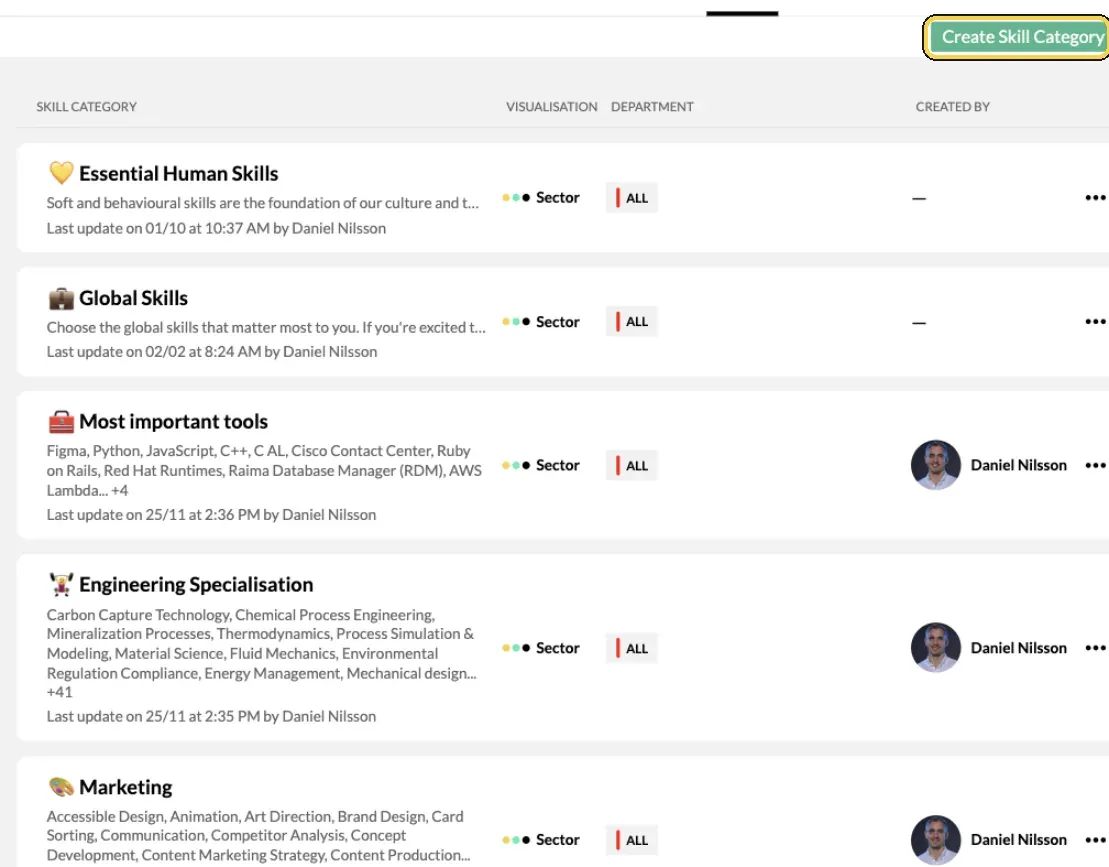
Team/Org › Settings › Manage Skills.
Add skills one by one
- Type the skill. Click Name of skill in the last row of the table and type. If the skill exists in the MuchSkills database, pick it from the list that opens.
- Add a description. Type it in the Description cell next to the name. Say what the skill means in your organisation. People read it when they choose skills.
- Choose the departments. Click All under Department(s) and pick one or more departments. Leave it on All to offer the skill to everyone.
- Press Enter. The skill is added and Skill was successfully added appears.
Add many skills from a CSV file
- Download the template. Click the three-dot menu at the top right of the category and choose Download template.
- Fill it in. Keep the header row with Name and Description. Add one skill per row, up to 100 skills per file, and save it as a CSV file.
- Upload it. Open the three-dot menu again, choose Upload CSV file (max 100 skills) and select your file. The skills appear in the table.
- Check the descriptions. If a row in your file had no description, MuchSkills writes one and shows Generating description… until it arrives. Read them and edit any that don't match how your organisation uses the word.
- Set departments. The file carries names and descriptions only, so every uploaded skill starts on All. Change the skills that are only for some departments.
Start from a template
For a full worked example, download our example skills taxonomy for a fictional company, Acme Inc: 12 categories and 371 skills, each category on its own sheet with Name and Description columns, ready to adapt and upload.
- Click + Add template. The Skills templates window offers pre-curated sets, for example languages or industry experience. Pick one and its skills are added to the category. Edit or remove any you don't need.
Set what each level means (optional)
- Open the level descriptions. In Manage Skills, click Edit skill level descriptions in the left column, or choose Edit level descriptions in a category's three-dot menu.
- Pick the category. Under Skill Category, choose Default or one of your sector chart categories.
- Start from a preset. Click Reset to... and choose the closest one, for example Soft skills default, Industry Experience Default, Yrs of experience default or Languages Default.
- Edit the wording. Click a level's name or description and type. Changes save on their own and Your updates have been saved appears.
Check it worked
- Manage Skills lists the category with its Visualisation and Department.
- Open My Skills yourself. The category shows under Skills my company wants me to specify, with its description.
- Click + Add/Edit in the category. The skills you added are listed to pick from.
Keep the category up to date
- Rename a skill. Click its name in the table and type. If the new name matches a skill in another category, MuchSkills asks whether to merge the two. Merging can't be undone.
- Remove skills. Use the three-dot menu at the end of a row and choose Remove. To remove several, tick their rows and click the delete button at the top, which shows the count, for example Delete (3) Skills.
- Edit the category. Click its name at the top of the table to change the name, description or icon, then click Save and continue.
- Reorder categories. In the Manage Skills list, drag a category to a new position.
- Delete a category. Choose Delete Category in the three-dot menu and confirm with Yes, remove. This can't be undone, so export or note anything you need first.
Tips
- Write descriptions in your own words. A short, concrete description keeps ratings comparable across teams.
- Spell shared skills the same way. If a skill belongs in two categories, use exactly the same name in both.
- Keep bubbles for fun or focus. Interests and preferences work well as bubbles. Anything you want to analyse belongs in a sector chart.
- Need required skills for a role? Build a role list in Analysis. See Define roles and competencies.
Troubleshooting
| What you see | Why | What to do |
|---|---|---|
| Your file must have "Name" and "Description" column headers. | The first row of the file is missing or named differently | Start from Download template and keep its header row |
| Your file contains more than 100 skills. Please reduce the number and try again. | The file has more than 100 rows of skills | Split it into several files and upload each one |
| We couldn't upload your .csv file. Please check the format and try again. | The file is not a CSV file, for example an Excel workbook | Save it as CSV (comma separated) and upload again |
| This skill already exists in the category | A skill with that name is already in the table | Edit the existing skill instead |
| Category name is already taken | Another category has the same name | Choose a different name |
| A skill name is greyed out and can't be edited | It is a prebuilt skill from the MuchSkills database | Change its description, or add your own skill with the new name |
| Employees say they can't add a skill to the category | People can only pick skills an Admin has added | Add the skill in Manage Skills |
| Someone does not see a skill | The skill is limited to departments they are not in, or they have no department | Set the skill to All, or give the person the right department in Manage Members |
Frequently asked questions
Should we add software and programming languages to our own category?
No. MuchSkills already has more than 12,000 technical skills in the built-in Technical skills category, and keeps them up to date. Adding them to a category of your own creates duplicates and confuses people when they add skills.
Sector chart or bubbles: which should we choose?
Sector Chart for almost every category. People rate each skill on the nine-step scale, so you can compare and analyse levels. Bubbles suit things that can't be measured on a scale, such as working from home, international travel or games people like to play.
Can we switch a category from bubbles to sector chart later?
Not from the category's settings, which change its name, description and icon. Create a new category with the other visualisation and add the skills to it.
Can employees add their own skills to a custom category?
No. People can only pick skills you have added. If someone tries to add a new one, MuchSkills asks them to contact an Admin. Add the skill in Manage Skills and it appears in their list.
Who sees a skill that is limited to one department?
Only people in that department are offered it. A skill set to All is offered to everyone. A person without a department only sees the skills set to All.
Can the same skill sit in two categories?
Yes. Add it to both with exactly the same name and spelling, so it stays one skill across your taxonomy.
Why can't I rename some skills?
Skills that come from the MuchSkills database are prebuilt and can't be edited. You can still change their description in your category. To use a different name, add it as a new skill.
How many skills can we upload at once?
Up to 100 skills per CSV file. For a longer list, upload several files to the same category.
Can we make a skill mandatory for a role?
Manage Skills decides who is offered each skill. To tell people which skills their role needs, and at which level, create a role list in Analysis and publish it. Everyone then sees their fit in My Growth › Gap Analysis.