


Run a skill gap analysis
- Who
- Managers, HR and L&D, Admins
- Where
- Team/Org › Analysis
- List types
- General analysis, Company role, Compliance requirements
- Employees see
- My Growth › Gap Analysis
A skill gap is the difference between the skills you need and the skills you have. In MuchSkills you describe what you need as a list in Analysis, with required levels and prioritised skills. The list then shows where the gaps are, across the organisation, per team and per person, and every employee sees their own gaps in My Growth.
How it works
A skill gap is the difference between the skills you need and the skills you have. In MuchSkills you describe what you need as a list in Team/Org › Analysis. MuchSkills compares it with everyone's profiles, all the time, so the gap analysis stays current as people update their skills.
One list gives you four views, as tabs:
| Tab | Shows |
|---|---|
| Skills analysed | Each skill with its level distribution, the percentage of people who have it, where it is found and how many members have it |
| Members | Each person's match, with prioritised and remaining skills side by side |
| Your skill gaps | Your own gaps against the list |
| Learning material | Courses linked to the skills and certifications in the list |
When you publish a list, every employee sees their personal gap in My Growth › Gap Analysis. Levels follow the bands of the skill scale: Expert in black, Intermediate in green and Beginner in yellow.
Before you start
- Know what you want to measure. A role, a team, a competence area or a set of certifications. One list per topic works best.
- Your skills taxonomy. Lists use the skills in your organisation's taxonomy. See Define roles and competencies.
- Up-to-date profiles. The analysis reflects what people have added and rated.
Steps
Create the list
If your roles and competence areas are already set up as lists, go to step 6. Every option for building a list is described in Define roles and competencies.
- Open Analysis. Click Team/Org › Analysis.
- Start with AI, or by hand. Click Create AI powered list and Describe a role, competence area or expertise you want to analyse. MuchSkills suggests a title and description. Click Save and continue. Or click + to build the list by hand.
- Set it up. Give the list a title and a description, and choose the list type: General analysis, Company role or Compliance requirements. Add Collaborators and Tags if you like, and choose Edit access rights. Click Create list.
- Add what you want to track. Use the two search boxes at the top of the list, one for skills and badges and one for certifications. With AI, ask for suggestions and use + Add all suggestions to start quickly.
- Set the bar. For each skill, choose Reqd. level. Click the star next to your most important skills, so they count as prioritised.
Explore the data
- Read Skills analysed. For each skill you see the Distribution across Expert, Intermediate and Beginner, the Percentage of people who have it, which departments it is Found Across, and the Total Members.
- Filter. Click Filter to narrow by department, location, manager, tag, job title or internal and external members.
- Choose a time range. Use the time range at the top of the list to see what changed, for example which skills people added in the last six months.
- Click a bar. Click a coloured part of a skill's bar to see who has the skill at that level, and where they are based.
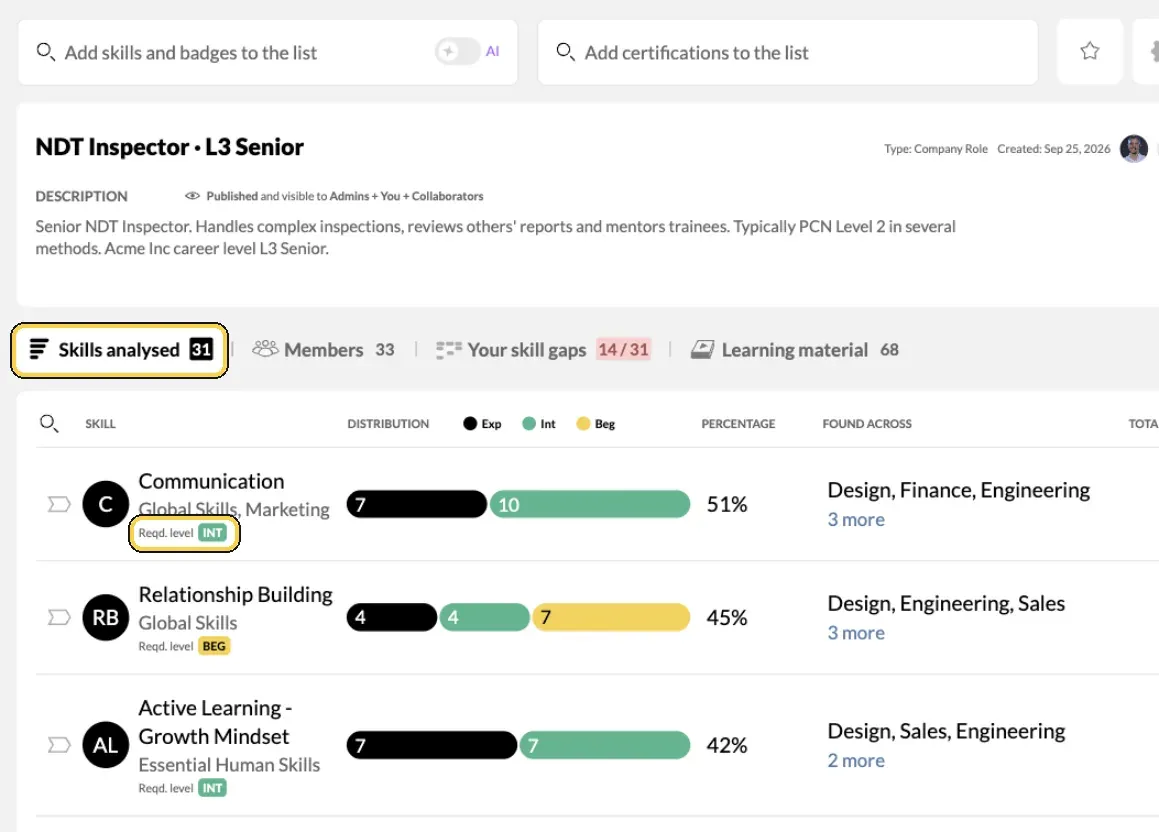
A role list in Analysis, with the required level per skill.
Find the gaps
- Look for the gaps. On Skills analysed, look for:
- skills with few or no experts
- skills where almost everyone is a beginner
- skills no one in the organisation has
- See real delivery capability. In the Distribution header, switch off Beginner. What remains is who can do the work today.
- Look at people. Open Members to see each person's match. Sort by Important to see who covers the prioritised skills, or by level.
- Compare groups. Apply the same list to two departments with Filter to see where a gap sits.
Share and act
- Publish the list. Use Launch list and choose who it is visible to. Until then it stays In Draft.
- Let people see their own gap. Each employee opens My Growth › Gap Analysis to see the lists they match, their personal gaps in Prioritised skills and Remaining skills, and learning material. They can update their profile or set a goal from there.
- Act on the gaps. Upskill people who are close, guide personal development plans, staff projects with the experts you have, and hire where no one can grow into the gap in time.
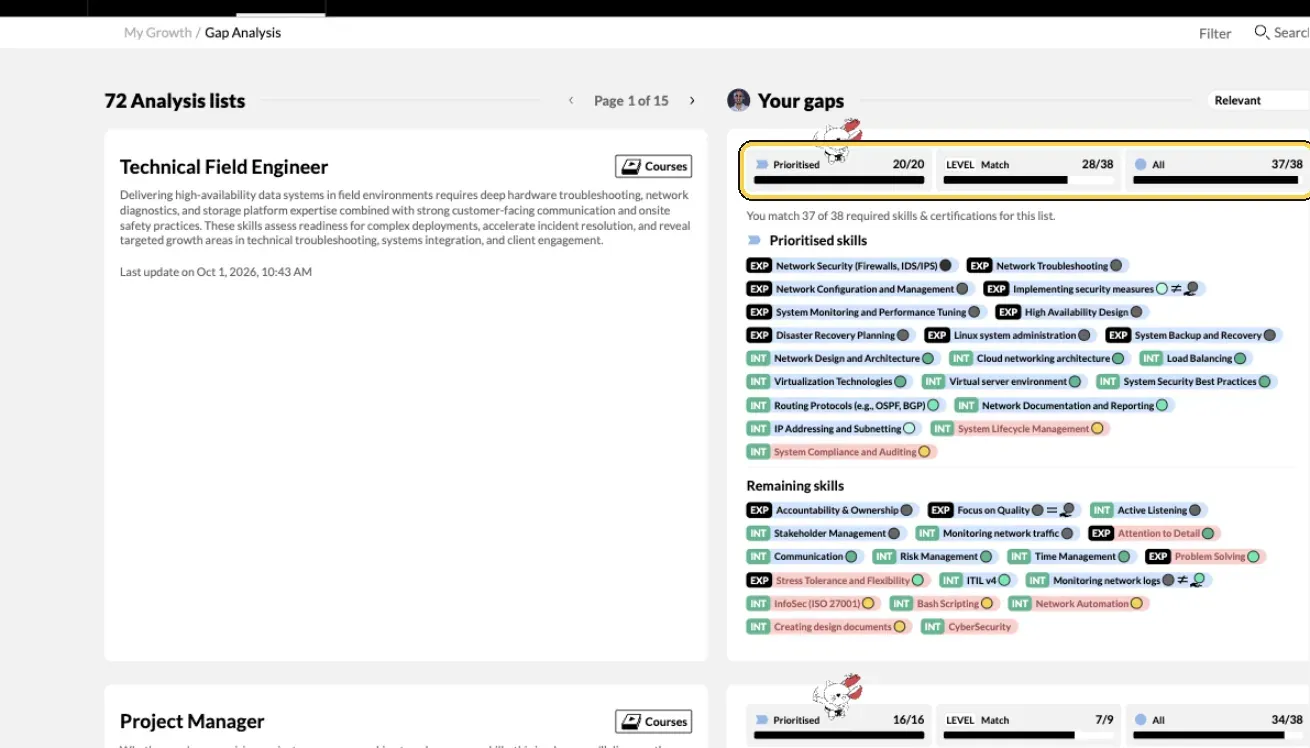
My Growth › Gap Analysis.
Tips
- Keep prioritised skills few. Three to seven per list makes the gaps clear.
- Look at trends. A time range shows whether a gap is closing.
- Add certificates and badges to role lists. A missing or expired certificate shows as a gap next to the skills.
- Link learning material. Courses linked to the skills in a list appear on its Learning material tab and in each person's gap analysis.
- Use lists beyond gap analysis. The same lists support workforce planning, internal recruitment, team planning, L&D programmes, leadership development and career conversations.
Troubleshooting
| What you see | Why | What to do |
|---|---|---|
| No skills to analyse against yet | The list has no skills | Click Add skills to list |
| Create AI powered list is missing, or asks you to upgrade | AI suggestions are not part of your plan | Click + to build the list by hand, or choose Create list manually |
| This name is already taken | Another list has the same name | Choose a different title |
| Employees cannot see the list in Gap Analysis | The list is still In Draft, or not visible to them | Click Launch list and choose who can see it |
| No data to show here yet in an employee's Gap Analysis | No list has been published yet | Publish at least one list |
| Too many requests. Please try again in a few seconds | Many AI requests in a short time | Wait the number of seconds shown, then try again |
Frequently asked questions
What can a skill list cover?
Anything you want to measure: a role such as Backend Developer, a team or department, a competence area such as Leadership or Customer First, or a set of tools or certifications such as programming languages or PMP. A list can mix skills, certifications and badges.
Which list type should I choose?
General analysis to look at a set of skills across the organisation. Company role to set the levels a role requires. Compliance requirements to list the certifications your workforce must hold and track who holds them.
Should I use AI to build the list?
It is a good start, where your plan includes it. Describe a role, competence area or expertise, and MuchSkills suggests prioritised and remaining skills from your own taxonomy. Review every suggestion. You can build by hand, use AI, or combine both.
What does the employee see?
When a list is published, every employee sees it in My Growth › Gap Analysis: how well they match it, their personal gaps in prioritised and remaining skills, and learning material. They can update their profile or set a goal straight from there.
How do I see real delivery capability?
On the Skills analysed tab, switch off Beginner in the Distribution header. You then see only the people at Intermediate and Expert, who can do the work today.
Can I see what changed over time?
Yes. Choose a time range at the top of the list to see the skills people added in that period, for example who added Figma in the last six months.
Who can edit a list?
In the list's settings, under Edit access rights, choose Only admins, owners and creators can edit, or Open for everyone to edit. Collaborators help you set the list up.
Can I take the results into a spreadsheet?
Yes. Use Export as CSV at the top of the list. The file has each skill with its required level, the number of people at each level, the percentage, where it is found and the members.