


How to build an audit-ready training matrix for ISO 9001 Clause 7.2
A grid of course dates tells an auditor who attended. Clause 7.2 asks you to show who can do the job – and what you did when someone couldn't.

If you own the training matrix in an ISO 9001 certified organisation, you probably expect the auditor to ask to see it. Most don't start there. They start with a record, such as a signed inspection report or a batch traveller, and the name on it. An inspector at your second site released a batch on Tuesday, say, and the auditor asks you to show why that person was competent, and authorised, to do it. Then they follow the thread: what the role requires, what this person holds, what proves it, what you did about the gap you found last year and how you know it worked.
A spreadsheet with course names across the top and ticks down the side can't answer most of that. It shows who attended what. It rarely shows what the role needed in the first place, whether the person can actually do the work, or what happened when they couldn't. That's the difference between a training matrix that looks complete and one that survives an auditor's trace.
This playbook is for Quality, HSE and QHSE Managers in regulated organisations of 200 to 10,000 people who own that matrix and answer for it at surveillance and recertification audits. It walks through building one in the order the work is actually done, with a template you can copy, one role traced the way an auditor will trace it, and a checklist for the audit pack.
What Clause 7.2 asks your matrix to show
Clause 7.2 of ISO 9001 is short, and every word of it lands on your matrix. In plain terms, it asks an organisation to do four things for everyone doing work under its control that affects the performance of the quality management system – employees, and agency staff and contractors too:
- Determine the competence each role needs – what the work demands, before any thought of courses.
- Make sure people are competent, on the basis of appropriate education, training or experience.
- Where applicable, act to acquire the competence – and evaluate whether the action worked.
- Keep documented evidence of that competence.
Two details in that list catch out more matrices than anything else. The first is that training is only one of three routes to competence. Education and experience count too, so a matrix that can only record courses forces you to pretend a 20-year machinist "attended" something before you can show they're competent. The second is that the effectiveness check applies to the action you took. If you sent someone on a course to close a gap, the auditor will ask how you know the course closed it.
That is why we use "training matrix" and "competence matrix" almost interchangeably in this guide, but build for the second. Training is an input; competence is what the clause asks you to prove.
What ISO 9001:2026 changes. ISO published the 2026 edition on 16 September 2026. According to ISO's quality management committee (TC 176), organisations certified to the 2015 edition have until 30 September 2029 to transition, and from 31 March 2028 new and initial accredited certifications can only be issued against the 2026 edition. Your certification body will set its own dates for the transition audit. The headline changes are a stronger focus on leadership, quality culture and accountability, greater clarity around risks and opportunities, and a new Annex A that explains the intent of the requirements. BSI's guide to the changes adds that awareness requirements, in the clause next to competence, now include quality culture and ethical behaviour. Check the exact wording of Clause 7.2 in your own copy of the 2026 edition. The method below rests on the four requirements above; if your copy words them differently, map the steps to the new wording.
Why training matrices fail audits
Before building anything, it helps to know where the usual training matrix breaks. These are the problems that come up most often in audits, each with the step in this playbook that fixes it.
- Courses instead of requirements. The columns are the courses the organisation happens to run, so nobody can say which ones a role actually needs. Fix: Define the competence each role needs first (Step 1).
- No levels. "Trained in CMM operation" says nothing about whether someone can run an inspection unsupervised. Fix: Set a required level for every skill requirement (Step 2).
- No expiry. Certificates and statutory training lapse quietly, and the matrix still shows a tick. Fix: a renewal interval on every requirement that expires, with alerts (Steps 2 and 5).
- "Trained" with no evidence it worked. The action is recorded; its effect isn't. Fix: Record what changed after the action (Step 4).
- One spreadsheet per site. Each site keeps its own version, and nobody can compare them or produce a group view for a multi-site audit. Fix: one matrix, filtered by site (Steps 2 and 5).
- Leavers deleted. When someone leaves, their row goes – and so does the history an auditor may ask for on work they signed off. Fix: Keep records for people who have left (Step 5).
If two or more of these sound familiar, the matrix probably needs rebuilding, and the steps below are the rebuild.
Step 1: Define the competence each role needs
Every training matrix that survives an audit starts from the role, because that's where the auditor starts. So before you open a spreadsheet, take one role and write down what someone in it must be able to do to produce conforming work. The same requirements apply to agency staff and contractors doing that work, and for outsourced processes ISO 9001 asks you to pass your competence requirements to the external provider (Clause 8.4.3).
Requirements usually come from four places, and it's worth walking through each one for every role:
- The work itself: the processes, equipment and decisions the role owns.
- Risk: what goes wrong if this person gets it wrong, from your risk assessment and past nonconformities.
- Customers and regulators: contract clauses, sector schemes (AS9100, IATF 16949) and customer-specific requirements. Special processes such as welding and NDT have their own qualification schemes, which set the requalification intervals your matrix records.
- Law: statutory training and licences for the country and site.
Then sort each requirement by type – a skill at a level, a certificate, internal or statutory training, a fitness or medical check, education or experience – because each type is evidenced differently later.
One rule keeps this step honest: The certificate is the floor, not the job. A certificate shows that someone met a standard on the day they were assessed. It doesn't show they can do your work, on your equipment, to your procedures. So a role that only lists certificates has described its minimum entry requirement and stopped there. Add the skills and the internal sign-offs that make someone safe to work unsupervised.
Only list what someone must have before they're allowed to do the work. A role profile for development can run to dozens of skills, but most of them don't belong here. If you find yourself adding "good communicator", ask whether you'd pull the inspector off the line for lacking it. If not, it belongs somewhere else.
Step 2: Build the matrix in two layers
With each role defined, building the training matrix itself is the easy part. It has two layers, and most spreadsheet templates mix them up.
The first layer is the requirements matrix: one row per requirement for each role, saying what is needed and what proof counts. The second is the coverage matrix: one row per person, showing whether they meet each requirement today. Build the first before the second, because the second is only as good as the requirements it checks against.
Here is a filled sample for one role. Copy the column headings for your own roles; the values are examples. Or download our free training matrix template (Excel), which has this sheet ready to fill in, plus sheets for people and evidence, coverage by role, and gaps and actions.
Requirements matrix – sample: Quality Inspector, Site 2 (example values – set yours from your own procedures and risk assessment)
| Requirement (type) | Required level | Review or renewal | Evidence that counts | Owner |
|---|---|---|---|---|
| Reading engineering drawings, including GD&T Skill | Intermediate (4–6) | Reviewed yearly | Level validated by the Quality Lead after observed inspections | Quality Lead |
| Running approved coordinate measuring machine (CMM) programmes Skill | Intermediate (4–6) | Reviewed yearly | Level validated by the Metrology Lead after supervised runs (writing or editing programmes is a separate competence) | Metrology Lead |
| Site inspection procedure (QP-07) Internal training | Completed | 2 years, or when the procedure changes | Training badge, plus a signed first-off inspection (production set-up approval, not AS9102 first article inspection) | Quality Lead |
| Near-vision check (fit for task) Medical check | Fit | 1 year | Fit-for-task record with date and next due; the clinical report stays with occupational health | Occupational health |
| Manual handling Statutory training | Completed | Set by your risk assessment | Certificate with expiry date | HSE Manager |
| Two years' inspection experience, or an engineering qualification Experience or education | Either | – | CV entry or qualification, confirmed at hire | Hiring manager |
Notice what the sample does that a course grid doesn't. The skills carry levels, so "can read a drawing" and "can make the call on a borderline part" are no longer the same tick. Every expiring item has a renewal interval. Experience and education sit in the matrix as legitimate routes, which is exactly what Clause 7.2 allows. And every row names an owner, because an auditor will ask who decides that the evidence is good enough.
The coverage matrix then reads off the requirements matrix, person by person:
| Requirement | Ana (Site 2) | Marek (Site 2) | Jo (Site 2, joined in March) |
|---|---|---|---|
| Drawings and GD&T – Intermediate | 8, validated | 7, validated | 3 – gap |
| Running CMM programmes – Intermediate | 6, validated | 4, validated | 4, validated in July |
| QP-07 training | Done, Feb 2026 | Done, Nov 2025 | Done, Mar 2026 |
| Near-vision check | Expires Jan 2027 | Expired Sep 2026; stood down from inspection until retested | Expires Mar 2027 |
| Manual handling | Valid | Valid | Valid |
| Experience or education | 6 years | HNC Engineering | 1 year – gap; works under supervision |
Ana meets the role in full, Marek is stood down until retested, and Jo is still building towards the role. That's a normal picture. A gap with a recorded control – a restriction, supervision, a booked renewal – is the system working. A gap where the person kept doing the work unchecked is a finding.
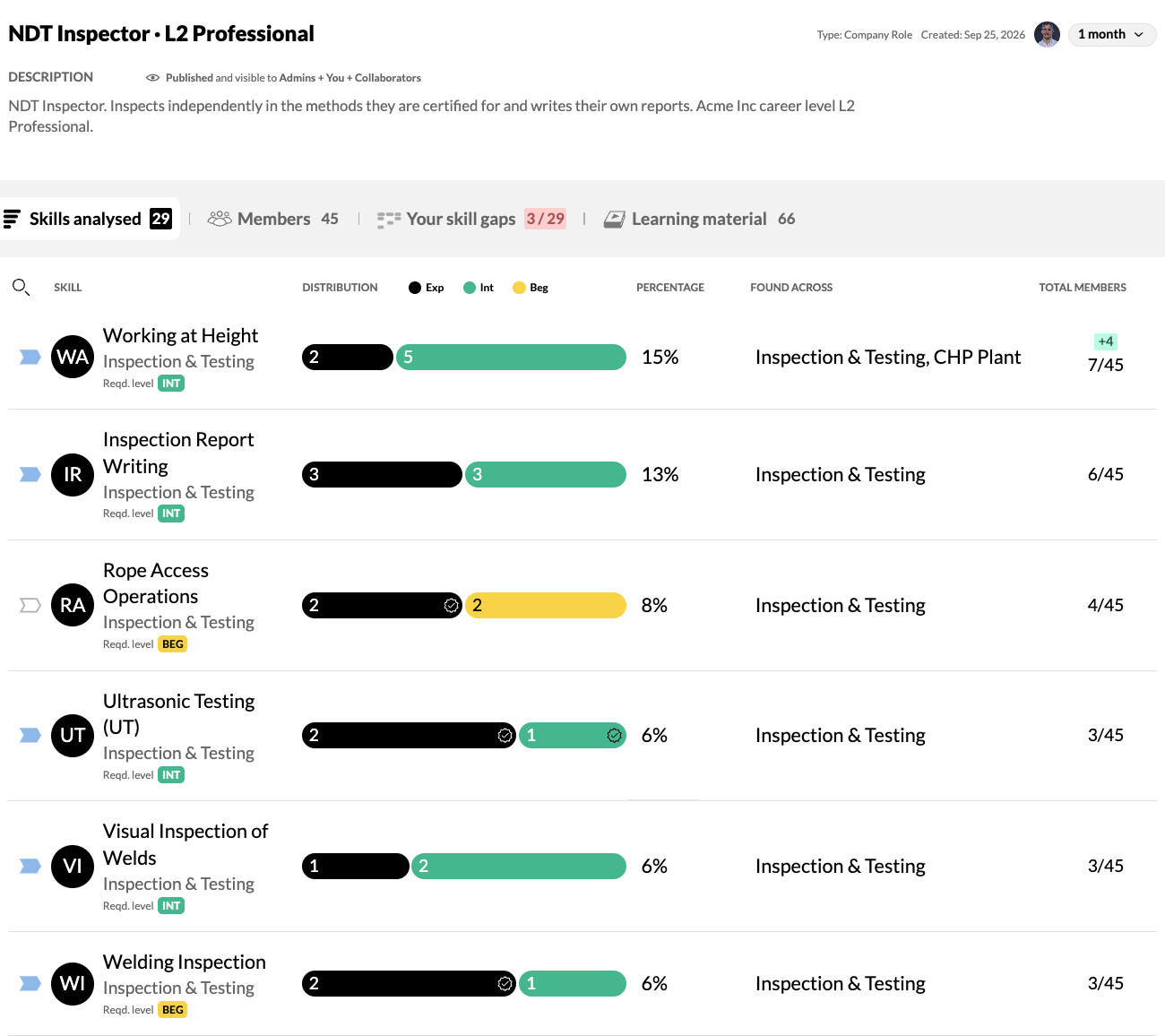
A role in MuchSkills: each skill with its required level, and how many people hold it at expert, intermediate and beginner level.
Many organisations add a third layer for tasks that carry sign-off authority: an authorisation list that says which inspections each person may release on their own, often tied to inspection stamp control. It answers the auditor's sharpest question about anyone with a gap – what are they allowed to sign today? Keep the two ideas apart: Competence is whether someone can do the work to the standard, and authorisation is permission to do it, or release it, on their own. Someone can be competent and not yet authorised, but should never be authorised without being competent.
Step 3: Record what each person holds and what proves it
Each cell of a coverage matrix is a claim about a person, and the evidence column you set in Step 2 says what backs it up. This is where most matrices go soft, because the easiest thing to record is a date in a cell, and a date proves very little on its own. If you're working in a spreadsheet, the People and evidence sheet in our template from Step 2 has columns for the evidence, the expiry date, and who validated it and when. For a single-sheet version for small teams, see our employee training record template.
Common forms of evidence are:
- A certificate with its proof file: issuer, number, issue and expiry dates, and the document itself kept with the record.
- A training record or badge for internal training, ideally with a sign-off showing the person applied it.
- A skill level validated by someone qualified to judge it: a manager, supervisor or assessor who has seen the work.
- A supervised sign-off for tasks where competence is shown by doing, such as a first-off inspection.
- Education or experience, confirmed once and kept on file.
Keep claimed evidence and validated evidence apart. If a person adds their own certificate, it's a claim until someone checks it – and in our experience people do upload the wrong one, or an out-of-date one, even with clear instructions. A matrix that shows which entries a manager has validated is far easier to defend than one where every tick looks the same. That check is what turns a list of claims into evidence, and an auditor will ask who made it and what qualifies them to judge.
Validation only holds up if assessors judge the same way. Describe what each level looks like for each skill, in terms someone could observe, and have assessors rate a few people together before they rate on their own.
Step 4: Close the gaps and check that it worked
Competence gaps are expected; Clause 7.2 is written around them. What the auditor wants to see is that each gap was noticed, that someone decided what to do about it, and that the organisation checked the result.
The action doesn't have to be training. Depending on the gap, it might be:
- Training or coaching, when the person needs a skill they don't yet have.
- Supervised work or mentoring, when the knowledge is there but the experience isn't.
- Reassigning the work while the gap closes, so nobody signs off what they aren't competent to sign off.
- Hiring, or contracting someone competent, when the capability doesn't exist anywhere in the organisation. (Our skills gap analysis playbook covers how to tell which of these you're facing.)
Then comes the part most matrices skip: evaluating whether the action worked. Here is the difference between an entry that invites a follow-up question and one that ends the conversation.
| Vague | Specific |
|---|---|
| Training effective: yes | Jo completed the CMM operator course on 14 May. Three supervised inspection programmes were reviewed by the Metrology Lead in June with no errors; CMM level re-rated from 3 to 4 and validated on 2 July. |
| Coaching given | An inspector at Site 1 shadowed a senior inspector on six borderline-part decisions last year, then matched the senior inspector's and the Quality Lead's calls on 19 of 20 borderline parts in an attribute agreement check a month later. |
The specific version names what changed, who judged it and when. Evidence of effectiveness is usually one of three things: observed performance, a re-assessed and validated level, or a measurable change in the work (fewer nonconformities, fewer escapes, fewer rejected first-offs). Choose the one that fits the gap, and decide it when you plan the action, so the evidence is collected as the work happens.
Step 5: Keep it current as people, certificates and requirements change
A training matrix is accurate on the day it's finished and starts drifting the next morning. Certificates expire, people join and leave, procedures change, and customers add clauses. So part of the build is deciding how the matrix stays true without one person chasing it by hand.
Four things keep it current:
- Expiry alerts with lead time. A reminder on the expiry date is too late to book a course. A common set-up is alerts at 90, 60 and 30 days before expiry and on the day, sent to the person who holds the certificate. Then give someone the routine of checking the status: the manager for their team, and the head of HR, L&D or compliance for everyone.
- Joiners checked against the role on day one. A new starter is added to the coverage matrix the day they start, so their gaps are visible from the beginning and the work they're allowed to do is clear.
- Leavers' records kept. When someone leaves, their record and history stay, because an auditor may ask about work they signed off last year. How long you keep them is a decision for your own retention policy, customer contracts and sector rules; write it down.
- A review whenever requirements change, and at least once a year. Roles drift. Lightcast's 2025 research on the speed of skill change found that over three years the average US job saw 32% of its skills change. Your inspection roles may move more slowly than that, but a new machine, a revised procedure or a new customer clause changes the requirements matrix overnight, and the coverage matrix has to follow.
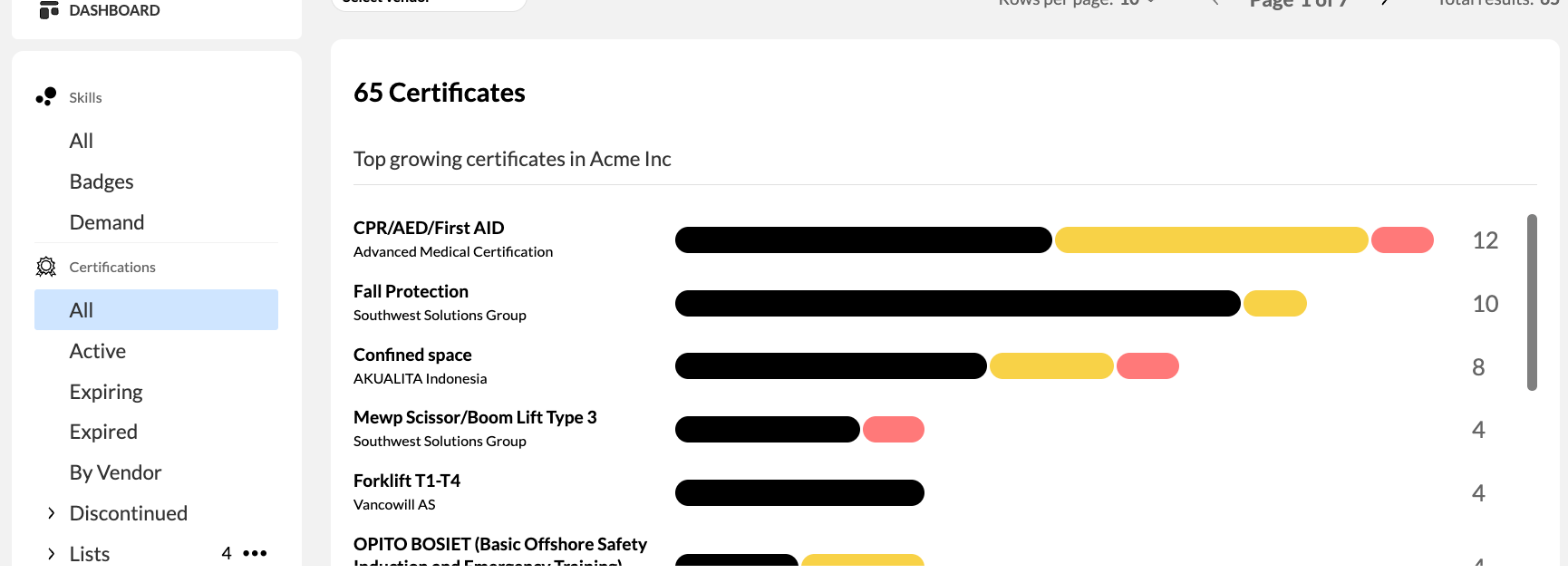
The certifications report in MuchSkills: for each certificate, how many people hold it, with black for active, yellow for expiring and red for expired.
Multi-site organisations should add one more rule: Keep one matrix and filter it by site. It's the only way to answer a group-level question ("how many people across all three sites are cleared to sign off first-off inspections?") without merging files the night before the audit.
Step 6: Trace one person the way an auditor will
The best test of a training matrix is to audit it yourself, the way the auditor will: Pick one person and follow the thread end to end. Let's go back to Jo, who joined Site 2 in March.
- The role. Jo is a Quality Inspector at Site 2. The requirements matrix shows what that role needs, who owns each requirement and when it was last reviewed.
- The requirements. Six requirements, two of them skills with required levels.
- What Jo holds. QP-07 training is done, with a signed first-off; the eye check is current; manual handling is valid. At hire, Jo's CMM and GD&T levels were below the required level, and Jo had less than the two years' experience the role asks for. Jo doesn't meet that requirement yet; the supervised period recorded at hire controls the risk while Jo works towards it.
- What was done about it. Jo was booked on CMM training, paired with Ana for borderline decisions, and restricted from signing off first-off inspections alone. The restriction is recorded.
- Whether it worked. CMM level re-rated from 3 to 4 after supervised programmes, validated on 2 July. GD&T is still in progress, and the restriction still stands.
- The history. Every change to Jo's records – who made it, when, and what it was before – can be shown.
If you can walk through those six points for any name on the list without opening a second file, the matrix is audit-ready. If you get stuck at step 4 or 5, that's where to work next.
Questions to rehearse before the audit. Questions like these come up whenever an auditor traces competence. Try them on three names chosen at random:
- How did you decide what competence this role needs? When did you last review it?
- Show me the evidence that this person is competent for the task they did this week.
- This certificate expired in September. Was the person working in the role after that?
- You found a gap here last year. What did you do, and how do you know it worked?
- Who validated this skill level? What qualifies them to judge it?
- This person left in the spring. Can you show me their competence for the batches they signed off?
- How do you know the records at this site match the records at head office?
- What happens when a new procedure is issued – how does the matrix change?
The audit pack: what to have ready
A surveillance audit is far easier when the evidence has been gathered as part of normal work all year. Even so, it helps to check a short list at three points.
Before the auditor arrives
- The requirements matrix for every role in scope, each with a review date and an owner.
- The coverage view, filtered by the sites and departments being audited.
- A list of every certificate expiring in the next 90 days, with renewals booked.
- Open gaps, each with an action, an owner and the planned effectiveness check.
- The Step 6 trace, run on a sample of names.
On the day
- Any person's full record, with proof files, available on request, including people who have left.
- The change history for any record the auditor questions.
- Effectiveness evidence for actions closed since the last audit.
After the audit
- Findings and observations logged against the roles and people they concern.
- Any requirement the auditor questioned reviewed, and the requirements matrix updated.
- The next review date set.
Where MuchSkills fits
Everything in this playbook can be done in a spreadsheet, and the template from Step 2 is a free place to begin. At scale – more roles, sites and expiry dates, and an auditor who wants the history behind one cell – a spreadsheet stops keeping up, and that's where MuchSkills training matrix software takes over. Take Jo's trace again:
- When the auditor asks what the role needs: The Quality Inspector role is an Analysis list of required skills (each with a required level: beginner, intermediate or expert), certificates and training badges, showing who meets each one. Filter it by location, and one matrix covers every site.
- When the auditor asks what proves it: Jo adds certificates with proof files and the Quality Lead validates them, so claimed and validated evidence stay apart. More than 9,700 certifications are already in the database, and every change to a certification is logged – who changed what, and when – and the full history is always kept.
- When the auditor asks about an expired certificate: Alerts go to the certificate holder at 90, 60 and 30 days before expiry and on the day. Managers check the status for their team, and the head of HR, L&D or compliance can see all holders.
- When the auditor asks for everyone who worked on a batch: Choose the people in scope, former employees included, and download every certificate and proof file, named for the auditor.
- When you have to hold a number: The Monitor tool keeps checking that you have enough of what your compliance requirements or goals demand, for example at least 20 of one certificate and 40 of another, as people join and leave and certificates expire.
- When everyone must hold something: A report shows whether everyone in a group has a given training or certificate, and who does not.
MuchSkills connects to your HR system through more than 30 native HRIS connectors. It holds the competence evidence next to your learning system; it doesn't deliver training or issue certificates. For more, see our video on managing and tracking certifications, our certification tracking page, MuchSkills for compliance teams, our guide to employee certification tracking software, our article on proving Clause 7.2 competence across multi-site manufacturing and, for ISO 14001 and 45001, our six steps for competence compliance across three ISO standards.
Ready to stop rebuilding the matrix before every audit?
If your training matrix lives in spreadsheets across several sites, and every audit means stitching it together by hand, it's worth seeing what one live record looks like. We'll walk you through role requirements, coverage by site and the audit download on a setup like yours.
Frequently asked questions



Does ISO 9001 require a training matrix?
No. ISO 9001 doesn't name a training matrix or any other format. It requires you to determine the competence each role needs, make sure people have it, act on gaps and keep documented evidence. A matrix is the format auditors see most often, because it shows all of that in one place, but any record that shows the four things works.
What should an ISO 9001 training matrix include?
The roles in scope and what each one requires – skills at a level, certificates, internal or statutory training, fitness or medical checks, education or experience – and, for each person, what they hold, the evidence, who validated it and when, and any expiry date. Add the gaps you found, the action taken on each and how you checked it worked. Together, those show the four things Clause 7.2 asks for.
What is the difference between a training matrix and a competence matrix?
A training matrix records which courses people have completed. A competence matrix records what each role requires and whether each person meets it, with evidence. Clause 7.2 asks for competence, so a training matrix covers only part of it.
What did ISO 9001:2026 change for competence?
The 2026 edition puts more weight on leadership and quality culture, and, according to BSI, awareness now includes quality culture and ethical behaviour. Check the Clause 7.2 wording in the published standard; this guide's method rests on its four requirements. Certified organisations have until 30 September 2029 to transition.
How often should a training matrix be reviewed?
Review it whenever a requirement changes – a new machine, procedure, customer clause or regulation – and at least once a year for every role. Expiring certificates and training are a separate job: Track them continuously, with alerts well before the expiry date.
Put the playbook to work
MuchSkills gives you the live skills data these playbooks assume: who can do what, where the gaps are, and who wants to grow.